
Brace Height
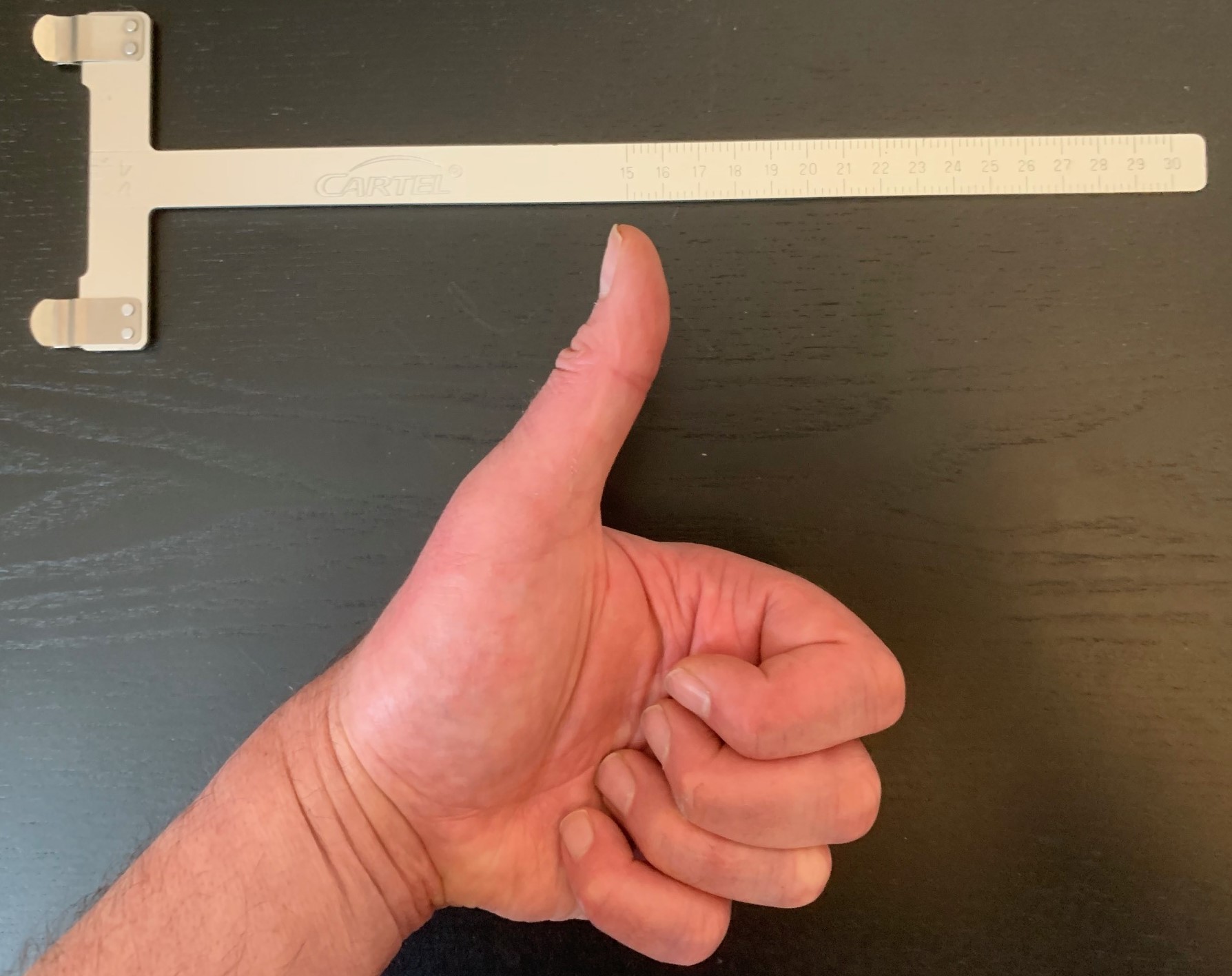
Noob Coach: can you spot the difference between these things? Veteran Archer: Meh, they're the same!
Brace height is one of those terms you hear thrown around on the equipment line that sounds like archers have lost what little sanity they had left. "I knew it was 1mm out" you'll hear and you'll probably scoff that anyone could be that precise or know their bow that intimately. <knowing grin> So, bracing height, what is it and more importantly, how and why do you fiddle with? Lets get into this mysterious subject.
First, what is it? It refers to the distance between the bowstring and the riser or stave when the bow is strung but not drawn. For every bow, there will be a sweet range in brace height where your bow will be operating at its peak. Think of it as getting your bows motor running as efficiently as possible. In the main you should consider that a lower brace height results in a faster if less stable arrow, as the arrow remains in contact with the string for longer allowing more energy to be transferred. And conversely, a higher brace height means a slower, more stable and likely a quieter arrow (important in hunting but not so much in target) with a higher brace height. Archers can and do fiddle with bracing height a lot which is what that T-square/bow square/bracing gauge thing is for (see pic - its the silver thing). Recurve, traditional and compounds all operate to different rules so lets take a look at whats under the hood.
Recurve, which also include bare bow, have bracing heights that tend to depend on the size of your bow. A rough guide recommended by most manufacturers for the three most common bow sizes are:
66" bow brace height should be 20.5cm - 22.5cm. A 68" bow should be 21.5 - 23.5cm. And 70" bow should be 22.5 - 24.5cm.

The gauge should be at 90' to the string.
These are starting figures for your brace height and they are measured as shown in the pic - string to the throat of your handle (sometimes people measure to the button). However, there is someone better suited to tell you exactly where the sweet spot is on your bow. No, not Captain Sausage .. Its your bow! Too high or too low a brace height and your bow will sound like a bag of bolts. It won't be happy so kicking extra vibration up your arm you feel in the form of hand shock and it will sound awful. This can happen when you are as little as a couple of mm out from THE ZONE which is why archers know there is something wrong. They know what their bow sounds like when its happy and odd sounds are a dead giveaway of something being iffy .. so ALWAYS listen to your bow. Most experienced archers will run their brace heights as low as possible for maximum oooff. Slowly lowering it till their bow sounds unhappy then increasing it back up until it edges into happy territory once more. (GA usual suspect .. if we're talking kit, you know who he is .. has got his brace height on a 70" bow down to exactly 20.5cm. 1mm lower, his bow is unhappy and he'll know. That's the precision you can play with).
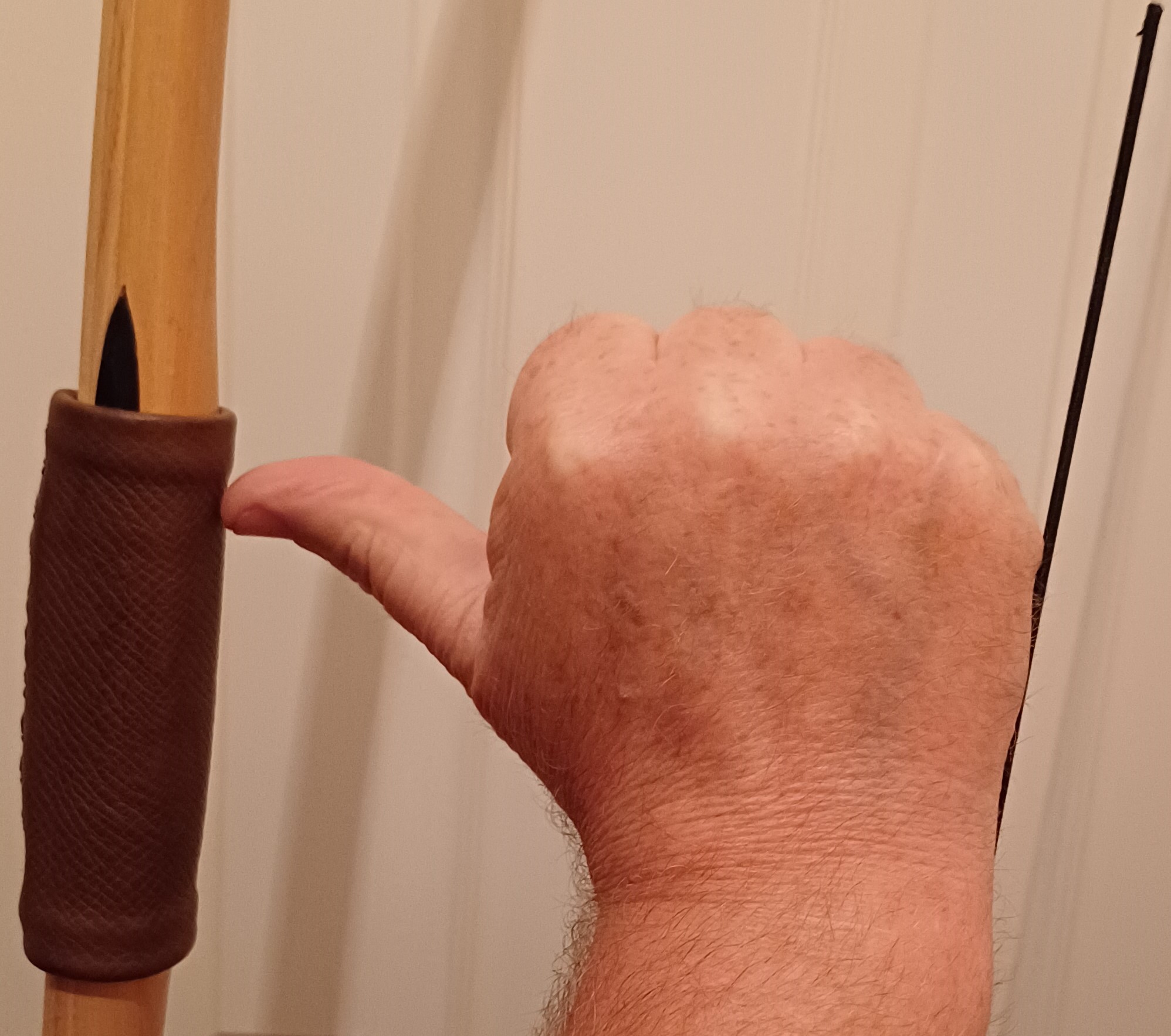
Fistmele in action
Traditional field, horse and flat bows bows have a brace height that are usually unique to that bowyers bows. They do tend to be quite low looking for the largest transfer of energy possible but in the main the bowyer will let you know whats best for your specific bow. The bracing height of a longbow however, has its methodology rooted in history. Again, its the measurement from the belly of the bow to the string. In the past, there were no Win&Win or Hoyt to tell you brace height ranges but there were rules. Traditionally longbow brace heights should be the equivalent of 1/12th of the length of the bow, measured from string nock to string nock. That would mean the bracing height of a 75 inch longbow is 6 1/4 inches (15.6cm). A rough guide to this measurement is given by the "Fistmele". This is a hard and fast way to measure the brace height of a longbow. What is a fistmele? Make a thumbs up gesture - that's a fistmele. If a longbow is strung correctly, there should just be enough space to fit your hand, in this form, between the string and the stave of the bow. This has also been known as the “Rule of Thumb”. Didn't know that was an archery term didja? Today, a rule of thumb is defined as a "rule or principle not based on exact calculations, but rather on experience". Historically, with a fistmele you were making a hard and fast check on your bow based on your archery skills and your hand thus .. rule of thumb!

OH GOD ITS A MM OUT!
But what if your bow sounds like a bucket of bolts? How do you change the brace height? Easy peasy! You adjust the brace height by the length of your string. Now strings are obviously fixed in length and you don't want to be repeatedly running out to buy/make a new string all the time. Here we change the number of twists in the string. Adding twists to your string shortens it so INCREASING the brace height. While reducing the number of twists DECREASES the brace height. As a very rough estimate, its one(ish) twists to 1mm of brace height although thickness of string does affect this. Thus a little bit of experimentation can result in MAXIMUM POWER MAXIMUM SPEED! (Editor: Sorry, Jeremy Clarkson moment there) or maximum stability. Less dramatically, it means you can come to the absolute lowest or highest brace height possible. This is how archers know their string is wrong. Just one twist too much or too little from the extremes .. and the bow will sound wrong instantly alerting the archer.
Wait, I hear you say. What about compound? Jeez, you want the moon on a stick don't you! Ok ... if we must.
Compound bows have generic brace heights of around 6 to 7 inches but this varies significantly as compound bows tend to be specialists. Compounds made for hunting and 3-D target shooting, where arrow speed is really important, typically have brace heights of 5-7 inches. This coupled with relatively small axel to axel size (ATA) maximises arrow speed and flat trajectories. Compounds intended primarily for target shooting (having larger ATA sizes) rarely go under 7 inches with even 8 and 9 inch brace heights not uncommon intended, as they are, for stability. In other words, most compound bows you see today tend to have set brace heights dependent on function. Even most professional archers usually just stick to these manufacturer recommended height settings in order to get the best performance from their bows. Result, compounders fiddle less with brace heights than other archers .. Tbh compounders have enough on their plate, just being compounders, without worrying about ANOTHER dodgy variable on those mechanical monstrosities.
So, there you are. Brace height. Working your bows engine like you are the Ferrari pit crew at Le Mans. If you ever go to or pass through Le Mans, we recommend visiting the museum at the track. Its .. very nice!
Ps: Some recurve bows can be longer than 70". This is achieved via longer limbs or by a longer riser or indeed both. 72" and 74" bows are not only possible but increasingly common on the line. So what are the bracing heights for these puppies? Uukha, who encourage such things through their longer limbs suggest 23.2cm for a 72" bow and 23.9cm for a 74" bow. They don't suggest an upper range but as you know the listen to your bow trick .. no big deal.
* * *
Many thanks to Bill who supplied the fistmele picture which he managed to take for us without breaking any arrows. Well done William.
Discover more from Glasgow Archers
Subscribe to get the latest posts sent to your email.

1 Response
[…] and everything seemed fine, but then the riser messages you via your wrist muttering about your brace height choices. You’re wondering where this is going. Don’t worry, this isn’t a physics lecture. This is a […]