Does the size of your Fletch matter?
At the non-pointy end of (nearly) every arrow are fletches. Also known as vanes, these tiny wings give your arrow stability and spin in flight. Depending on the tune of your bow or how good/bad your release is .. they may be working really hard to keep the arrow straight or they may be having an easy time of it. Their colour combinations identify your arrow in the boss, either during scoring or through your scope/binoculars/Mk1 eyeball, as well as being an expression of your personality/bow colour scheme. But are they all the same or different? .. Lets take a look:
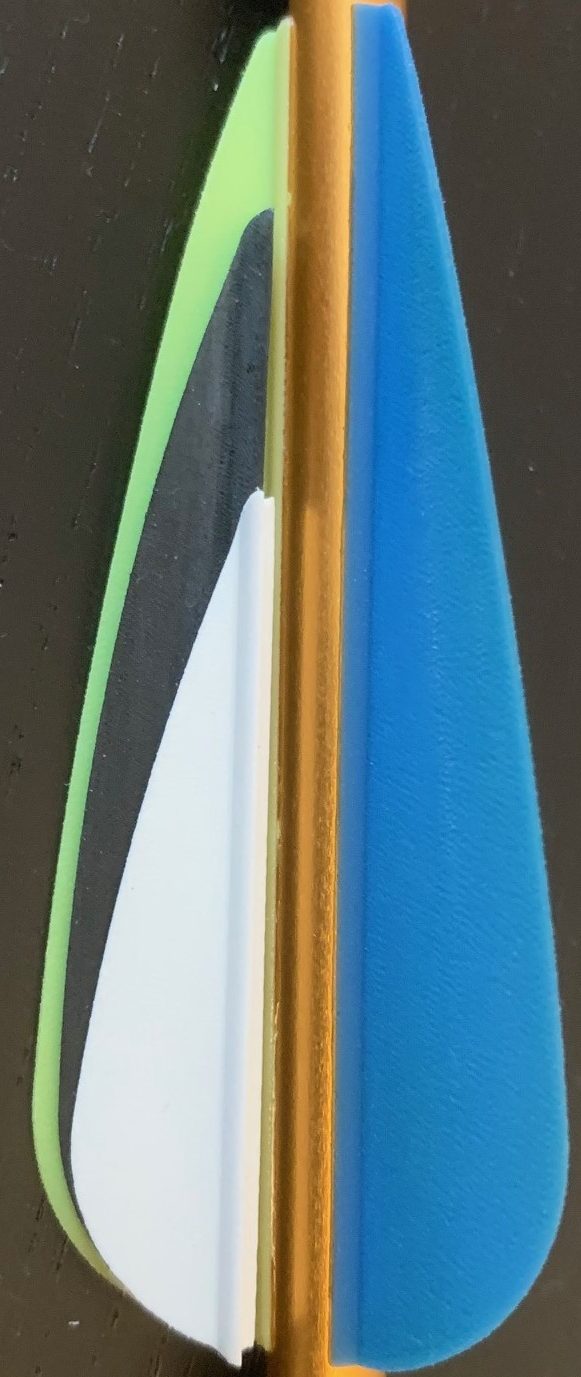
Green = EP26, Black = EP23, White = EP16
Vanes: These are the simplest and most durable of the fletches you can put on your arrows. Made of a tough vinyl material, they will shrug off a lot of abuse which make them ideal for high volume shooters and beginners. They are typified by AAE (Arizona Archery Enterprises) who have a large range of variants. For most product ranges, no matter the company, vanes can be boiled down to just 3 sizes with a few outliers/oddities. In AAE's terms, the EP16, the EP23 and the EP26 are the main sizes.
Let’s talk about the EP23 first which we recommend for newer archers. At 2 and 3/8" long, the EP23 is a good combination of size and clearance. There is enough fletch to stabilize the beginners dodgy shots but not enough to cause massive drag so limiting the range. It clears the riser easily without causing the drama that comes with higher profiles/lack of clearance. All in all this size of fletch, be it AAE or other brand, is perfect for the newer archer's aluminium shafts.
Its smaller cousin, the EP16, at just 1 and 3/4" is quite a bit smaller. Its stabilizing effects are much reduced but drag is minimized as much as is physically possible. This is a fletch for carbon arrows which are required to reach out to 70m and perhaps beyond. If you klutz your shot, these fletches are not going to help much so newer archers need to improve their consistency before moving onto these. All vanes require to be glued onto the arrow either with a superglue style fletching glue or with a rubberised one. They are often fletched with the tip of the vane offset by 1-2' from straight. This causes the arrow to spin in flight helping accuracy/stability at the longer distances.
The EP26 is something of the unwanted stepchild (at least in the recurve fraternity). It's a very large fletch at 2 and 7/8" long with a quite large profile. This fletch generates huge stability and drag BUT invariably causes issues with clearance from a recurve riser when the arrow is released. Recurvers tend to avoid this puppy although compounders with their launchers are unlikely to have the same issues and will benefit (at least indoors) from the large surface area and instant stability.

A curvy boi
Spinwings: Sometimes called spin vanes, these differ from traditional feathers or normal vanes because of their curved profile. These rather odd looking fletches are designed to make the arrow spin in flight in exactly the same way rifling in a barrel affects a bullet. The rotation imparted to the arrow stabilizes the flight making it, in theory, more accurate. Increased drag from the spinning effect should also help somewhat with stability. Spinwings are not glued on. They use strips of double-sided tape to attach to the arrow. To seal the ends thin strips of plastic tape are wrapped around the shaft and fletch ends to ensure they don’t rip off in flight. Entirely used on carbons as they are rather small, they are extremely popular with high skill archers looking for every grain of advantage. But as with everything in archery, there is a trade off , in this case verses normal vanes.
While less messy to attach than traditional vanes and ready to shoot much faster, they have a tendency to part company from the arrow if shot through the clicker or impacted by another arrow when in the target. This can lead to hilarious scenes of archers frantically refletching arrows between ends. They are also susceptible to tearing or being chunked if there are any clearance issues since the material they are made from can be brittle and/or so light as to be fragile. Definitely an fletch for the more experienced archer.
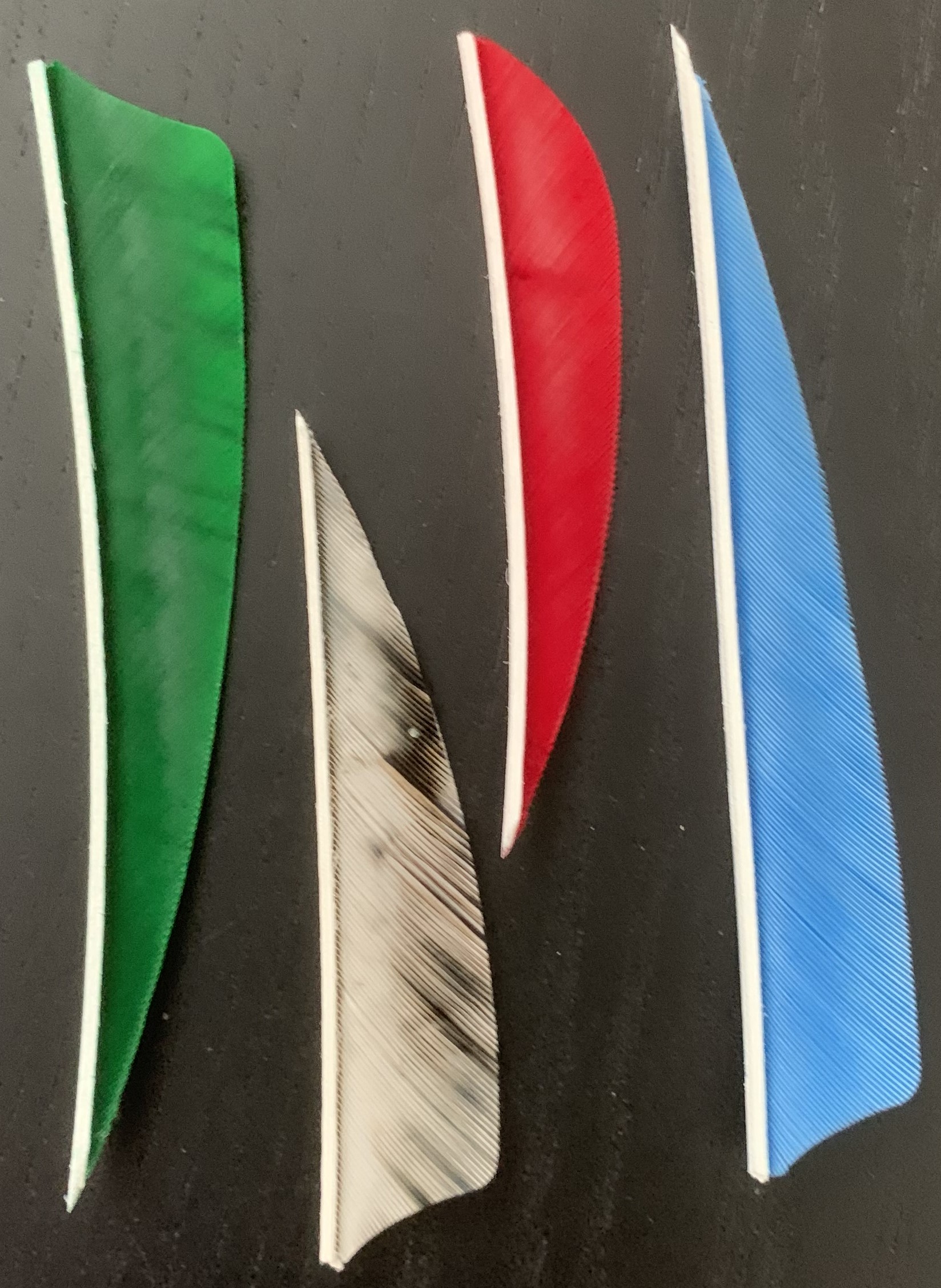
Two 4" Shields, a 3" Shield and a 3" Parabola
Feathers: Definitely falling within the realm of the traditional archer (with the odd exception), feathers come in two main shapes - parabola and shield.
The shield is the more traditional feather shape on an arrow as shown in every medieval subject matter film you've ever seen. They provide a great deal of stability but will slow arrows down faster than parabolas will. They will be a little more noisy in flight and will have more contact with the stave/bow on release. Parabola shaped fletches give good stability but not as much as the shield shape. They are a little quieter in flight and don’t have as much contact getting away from the bow. It’s usually a little easier to helically attach parabola fletches to the arrow. To be honest, given these fletches are mostly used on arrows for traditional bows, only a little real advantage is gained shooting one compared to the other so go with the aesthetic you want. So don't worry too much about shape unless distance is a major consideration where parabola and smaller (3") would be best.
Feathers can get damaged very easily with the feather's barbs breaking or losing their ability to hook onto other barbs. When they get wet, they look like a half-drowned rat with the same aerodynamic properties. Damage doesn't always mean the feather needs replaced til it gets significant. A scabby looking soggy feather once dried out can be revitalized with steam.
Some recurvers and compounders will put parabola feathers on their big chunky indoor aluminiums looking for maximum stability right off the rest. (Geo does on his X7's) Here parabola feathers are preferred, especially by recurvers, for big fletching as they don’t have the same clearance issues as EP26's since feathers are not as rigid as vanes. However, they do have the same stabilizing effects. Finally you can make your own custom feather shapes by buying full length feathers and cutting them to preferred size and shape using a special feather chopper, scissors or burny tool (heated wire).
I got the fluflu
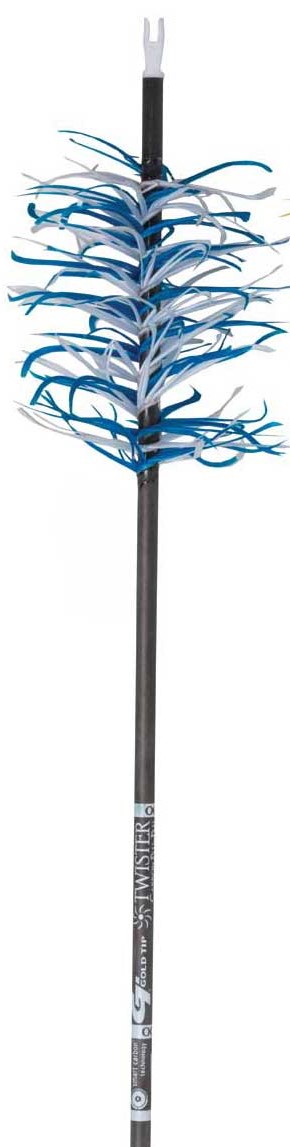
FluFlu's: The FluFlu fletch is something of an oddity. Its purpose is to slow the arrow down, killing the arrows flight after about 30m. While that sounds a bit stupid, it does have a real-world application. In bird hunting, if you shoot at a bird in flight* and miss, you don’t want your arrow going another 200 meters and impacting something inconvenient like a tree, BMW** or next-door neighbour. They can also be used for close-ish range practice, again where you don’t want the arrow travelling at high speed or having high penetration. FluFlu's when coupled with rubber tips make a good arrow for children.
These arrows are made slightly differently from normal arrow construction. Instead of the traditional three smallish feathers, very long feathers, usually six or more with a huge profile are used. Alternatively, two long fluffy feathers can be spiralled around the end of the arrow shaft. Both of these create a huge amount of drag so causing the arrow to slow down extremely rapidly.
No matter what sort of fletch you have on your arrows, its important you check them for damage or detaching from the shaft on a regular basis. Top end archers check theirs after every end as losing a fletch in flight will cost points. One of the first maintenance skills an archer should learn is how to refletch their arrows. The club has a couple of jigs you can borrow if you want to try your hand although you will need to order some glue and have your own replacement fletches .. glue perishes rapidly in the containers and we might not have your particular colour combination/size of fletch in the spares box. Gotta have those spares!
* * *
* Please note: hunting in the UK is prohibited by the Wildlife and Countryside Act 1981.
** We have a little bit of ambivalence about an arrow hitting a BMW. It would be a horrible safety violation and dangerous .. then again its a BMW! ;o)
Discover more from Glasgow Archers
Subscribe to get the latest posts sent to your email.