
Not quite 39 Steps ...
The shot cycle in archery, sometimes called shot process, sequence or routine is the series of steps you follow to make your shot. To get your arrows in groups, it should be exactly the same every time. Doesn't matter about the rain going down your neck, the battering by the wind or sun in your eyes. Every action taken by you should be identical. With no variables introduced by you, and the same external influences, your arrows will land close together. Ideally where you were aiming but they should be in a group where-ever they land. Well, that's the theory. Reality? .. MmmmMmmMmm!
So, how do you get at least vaguely close to that slightly robotic ideal? Well first, you need to learn your shot cycle!
Below is the simplest breakdown of the typical shot cycle in archery sometimes called The Nine Steps:
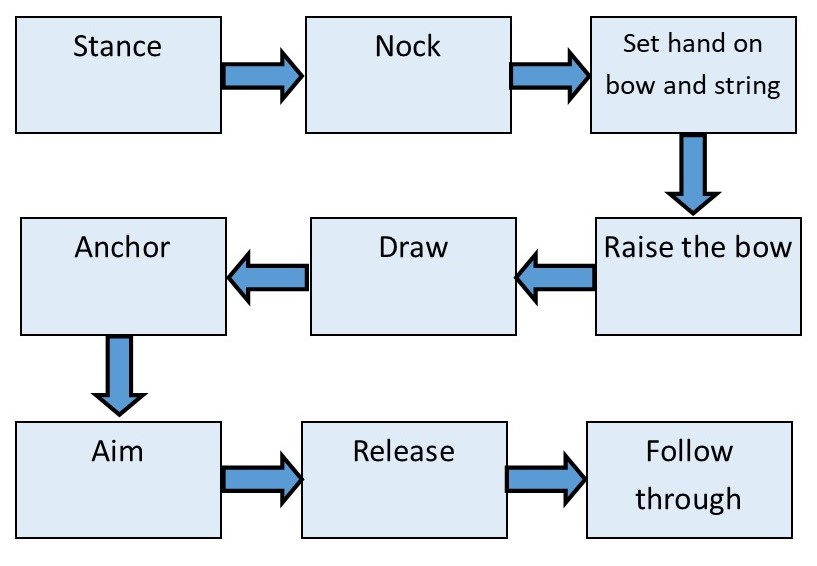 We all know how to shoot an arrow but what actually do you do? To understand your shot, write it down in as much detail as you can. Your specific shot. Exactly what you do. Imagine you are shooting your shot. Break each step, as noted right, down. From first and third person views. Get to know your shot. If you don't know what you do on the line, how are you going to repeat it? Random actions sneaking into your shot will cost you points.
For example: Stance .. (1) our archer approaches the line clipping his wrist sling into place. (2) he straddles the line checking his feet are correctly orientated (open stance) to the target. (3) looking at the target, he (3a) stands up straight (3b) shoulders back (3c) tucks his butt in (3d) relaxes his shoulders. A little more complex than "stands on line". He's secured his bow, orientated his feet and therefore his body, got his posture correct and is now ready to shoot in a stance that should remain constant throughout the end. All that activity condensed into one word.
Having this down on paper in detail not only reinforces how your shot is made up, but also lets you look at each step in isolation. For example: Follow Through. Looking at your steps here you might realize that you have a forward release as your hand is still at your anchor position after the arrow has gone. Its not dynamic and you are losing power on the shot. Asking someone to watch and comment, even narrate your release/follow through would let you improve your understanding of that part of your shot in isolation rather than just being a small bit of the overall motion. Getting someone to film your shot on your phone is another helpful approach. You actually get to see what you are doing without the distraction of actually shooting. One of our experienced archers got caught in a forward release when filmed even though you can't see it in real time.
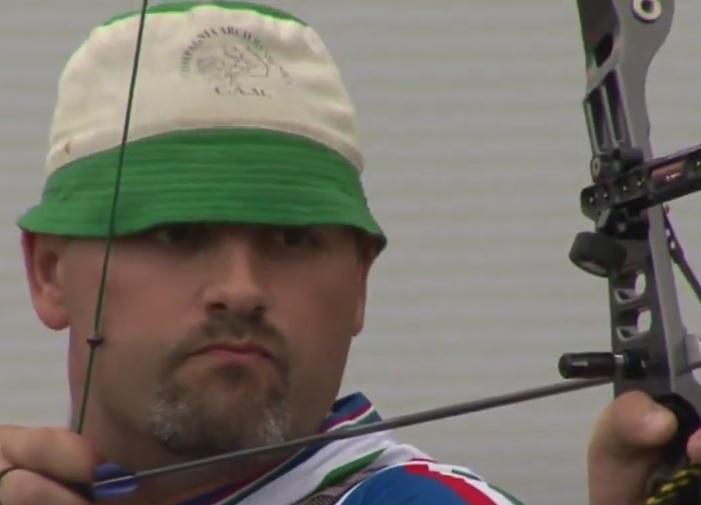
5 minutes into the shot and he's still going!
Once you have your shot cycle down and know each step intimately, you can summarise it down to a simple set of key words which simply act as a focus for the process. Some archers have printed out their cycle and stuck it to their top limb as a reminder til its locked into their brains. And this doesn't need to to be a one and done process. You can come back to imagining your shot cycle again and again. At your desk, in the shower, drifting off to sleep. Refining that shot process further. And the good thing is, your shot will always be as smooth as butter and the arrow always hit gold. You just need to transfer that mental image of your shot to reality.
One of the most bizarre shot cycles belongs to Italian recurver Michele Frangilli. Here he is at the 2012 Olympics winning team gold with no time on the clock! Seriously, this shot is worth a look. Watch it a few times focusing on the different things going on - examine hand, bow, string, face separately. We don't recommend copying his form but can you imagine how many A4 sheets it takes to document this insanely complicated shot. The book he wrote is called the Heretical Archer .. he's well named!
* * *
On the subject of Michele, at the 2010 World Cup in Edinburgh, this archer was stopped at the entrance to the competition area by a security guard with the words "Can I see your pass please Mr Frangilli?" The security guard was our own Dave Hutton, a well known Michele Frangilli fanboi.
Discover more from Glasgow Archers
Subscribe to get the latest posts sent to your email.


3 Responses
[…] string in the same place when you shoot. How do you do that? You need to add another step to your shot cycle. Right after you have come to anchor and are aiming .. glance at the fuzzy outline of the string […]
[…] am glad you asked. I have claimed often enough that one’s shot sequence, aka shot routine, is a guide to an archer’s attention. One thing after another, one attends to […]
[…] able to perform unconsciously.” In other words, you form shooting habits stitched together with a shot sequence/shot routine. And what are you supposed to be thinking about while […]