
Gossip Behind the Tent Line: An 'Arrowing Time?
 One of the more popular aluminium/carbon arrows in recent years has been the Alimax shaft from Merlin Archery. It carved out a reputation as an affordable first A/C arrow that performed well. We certainly thought so in back in March 2023. Prices have crept up a little recently, but they still represented good value. Over the last few months, however, we've become aware of more reports than we had previously seen describing a very specific failure.
Before getting tore in, let's remember one thing: arrows are consumables. Even X10's eventually meet their end .. to the shock and horror of archers. Manufacturers spend millions developing carbon composites capable of surviving launch accelerations of hundreds of G. Then we immediately test them against the only material harder than diamond... the wooden target frame. Some arrows give faithful service for years, some last weeks, and some take one look at a wooden frame and decide their time on Earth is over.
So, back to the Alimax. The failures we've seen all look remarkably similar. After striking wood, portions of the central aluminium core separate from the outer carbon sleeve. The point remains in the wood, the ali core is still attached to the point but the carbon outer pulls free. Two years ago we saw a couple of examples that appeared to be isolated incidents. More recently, we've seen enough similar cases to wonder whether there is a pattern.
Why might this happen? Good question because we're seeing effect, not the cause! There are several possibilities. The adhesive bond between the aluminium and carbon could fail, the adhesive itself could tear, or the carbon laminate could fail after a severe impact. Bonded composite structures rely heavily on careful manufacturing and surface preparation, so even a small variation in process could potentially affect durability. Equally, there may be another explanation entirely. Damn it Jim. We're archers, not composite structure specialists!
The issue came into sharper focus at the recent West of Scotland Championships. While gossiping, one archer reported having lost eleven over the past year or so to this problem, including three at a single shoot, forcing him to complete the championships with borrowed arrows. Another archer lost four Alimax arrows during the championship itself, all in exactly the same way. One particularly dramatic example occurred when her Alimax buried itself in the wooden cross-member at the bottom of a target frame. On removal, around eight inches (20cm) of aluminium tube and the point remained in the wood while the outer carbon sleeve separated.
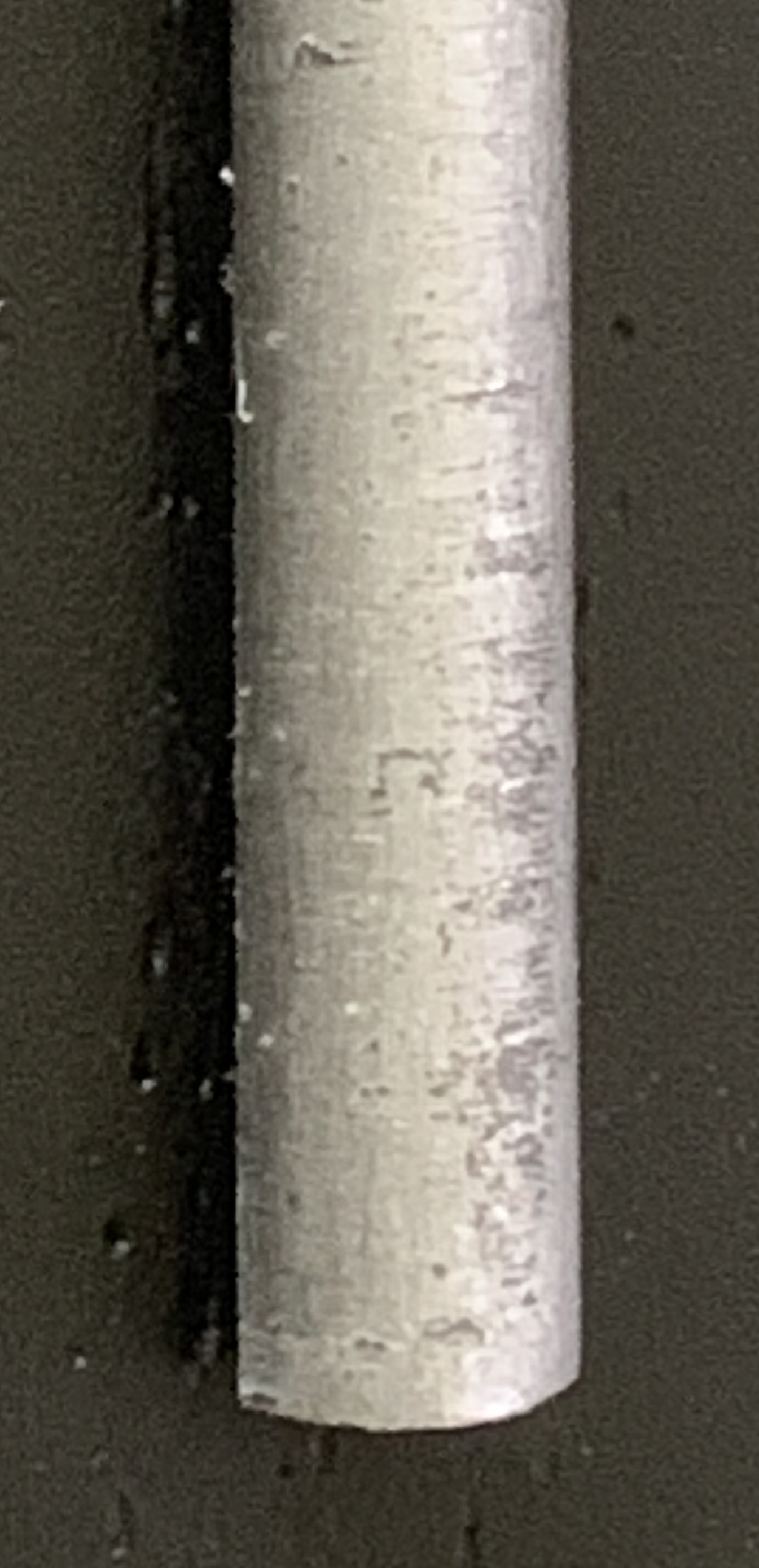
core has a dull, rough outer surface with two tone colouration
One possible explanation is something composite engineers call "interfacial delamination". Archers would call it "oh no, not again!". This is where a crack propagates along the bond between two materials. Once such a crack starts, it can travel surprisingly long distances because the adhesive layer is extremely thin. We examined several failed shafts provided by local archers. And although this is far from a scientific investigation, the failures appeared remarkably similar. The outer surface of the aluminium tube appeared rough and dull. Whether that observation is significant is something only a suitable materials expert could determine. We also found a small number of online reports describing comparable experiences. Those accounts are anecdotal and we cannot independently verify them. They do, however, suggest that the examples seen locally in Scotland may not be entirely isolated.
Several archers told us they had been advised that impact damage is not covered by warranty and that "striking wood falls outside normal use". That is entirely understandable, as all arrow manufacturers exclude impact damage from their warranties (voidance of warranty). Lets be real here, wooden frames have never respected warranties. It should also be noted that during the same championships we saw numerous Easton arrows strike wood without comparable failures, although one competition is far too small a sample to draw broader conclusions.
Where does that leave us?
 We contacted Merlin Archery before publication and they provided a response (ta guys). In summary, they stated that impacts with wooden target frames constitute misuse rather than normal operation and are therefore not covered under warranty. They also advised that similar internal damage can occur with arrows from other manufacturers after striking hard objects, and noted they have received only a small number of complaints relative to the number of Alimax shafts sold. We have no independent way of verifying those figures, but they provide useful context alongside the experiences described above. Finally, they recommended that archers inspect any arrow after a significant impact, advice that is sensible regardless of the manufacturer. Their full statement can be found here.
At present there appears to be enough anecdotal evidence to justify asking questions, but not enough to draw firm conclusions. We are not suggesting that every Alimax arrow is affected, nor that a manufacturing defect has been established. Our aim is simply to share the experiences that a number of archers have reported and encourage careful inspection of any arrow that has suffered a significant impact. Never ever shoot an arrow that shows any damage. If additional information becomes available, or Merlin provides further clarification, we'll happily update this article or more likely, write another. Until then, perhaps the best advice is the advice that's always been true in archery: try to keep your arrows in the foam/straw rather than the woodwork. You'll probably score better too.
* * *
Note: Among the examples we've encountered, the affected archers used a variety of bow styles and draw weights, and included both men and women.
Discover more from Glasgow Archers
Subscribe to get the latest posts sent to your email.


2 Responses
[…] The first is Merlin Archery's ALIMAX shaft. Coming in at £150 for the dozen, this price is very much in the ACC's ballpark BUT even better, the shafts come bundled with break off points, nock pins and small groove nocks. That's close to a £30 saving on Easton's ACC pricing where you only got the shafts. Spine range is from 350-1000 serving the 70lbs compounder all the way to the 24lbs recurver. Taking the 600 spine arrow as representative, the shaft is a little beefier at 7.81gn/inch versus the ACC's 7.5 but the outside diameter of the shaft is almost right on ACG numbers making it much slimmer in profile. Correctly tuned, this arrow should perform a little better in crosswinds than the ACC who was always a chonky boi. We can't see anything about the shaft configuration but we're going to assume its a parallel shaft as that's the more likely option at this price. We could find no actual reviews as yet**. When they appear they will be interesting to read/view as this arrow, on paper, looks perfect for the new archer getting their first A/C carbons. (edited to add 8/26 .. Some Alimax arrows have been seen to be having issues when striking wooden frames. In these cases, the ali core has been separating from the carbon. Hoping to get more details in the near future) […]
[…] (note: there have been a couple of issues popping up with Alimax arrows in the last few months. We looked into these in this article.) […]