Gossip behind the Tent Line: The Cost of Missing
 A few weeks ago we had an article on the big indoor competition - Las Vegas 2026. We noted the fact that last year there was, over the weekend, $30,000 dollars of damage done by arrows that missed the bosses. Thirty. Thousand. Dollars. That’s not a typo. That’s the cost of a car, or roughly three compound releases and a packet of Cumberland sausages. Well, we’ve now got more details about last year’s chaos, plus any fresh carnage from this year. Word in your shell like .. that's what the movies would call "foreshadowing".
Vegas 2025 - One less than a golf course: Last year there were 17 misses. Seventeen. That’s not “a couple of bad shots”. That’s a coordinated attempt to assassinate a ballroom. Because the shoot was held in a Caesars Casino venue, those holes cost the organisers a chunk of their soul and that $30,000 (£22,500) which was effectively punitive charges. Caesars, it turns out, do not want their walls looking like a block of Swiss cheese and the organisers would like to return here. Some of the archers responsible scoffed at the bill, saying they could fix it for 50 cents. A bold claim, considering the wallpaper is:
- No longer made
- More ornate than a Renaissance cathedral
- Repaired by someone who probably charges by the brushstroke
Yes, the actual repair involved $5 of filler and 30 seconds per hole… but then a poor soul had to hand‑paint the wallpaper pattern back on. Seventeen times. Somewhere in Vegas there’s a man who wakes up screaming in damask.
So, that was last year. Obviously the shoot would be more prepared this year ... wouldn't they?
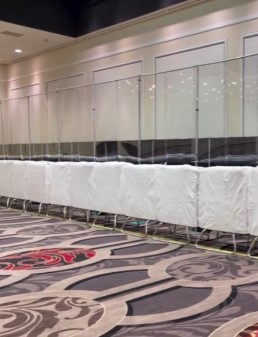
The Vegas 14ft tall yeet wall
Vegas 2026 - Surely They Learned?: Of course they didn’t. This year everyone was told to be more careful. A 14‑foot‑high impact plastic wall was erected behind the bosses. Fourteen feet. That’s taller than most excuses heard on a shooting line. And if you somehow managed to shoot above the plastic wall, you’d be fined $1,000 (£750) per hole. A simple system. A clear deterrent.
Did it work?
Err… No.
There were rumoured to be 12 in the wall this year - definitive numbers yet to be reported. These definitely included one arrow that hit 24 foot 6 inches up a 25‑foot wall. At that point the arrow isn’t missing — it’s trying to escape. That arrow had dreams. That arrow wanted to see the world.
Europe vs USA - A Cultural Exchange: Greg Poole of BowJunkie Media who was doing interviews asked European archers if this kind of thing happens at home. They all said no. Not “rarely”. Not “occasionally”. Just… "No". The kind of no that comes with a judge walking briskly toward you with a scowl and a clipboard. Our editor — who has shot everywhere from Le Mans to Largs — said he’d seen it once in 18 years. So it’s looking like an American problem.
But why?

Difficult to see but circled in yellow and red are two in the wall at the same target! The 14ft yeet wall is at the base of picture
The Culprit: In compound archery (yes, it’s them), you can get a whole buffet of failures: Release aid fails .. D‑loop snaps, resulting in a self‑inflicted punch in the mouth .. Release not hooked properly .. The classic negligent discharge where you are drawing with a nervous digit on the trigger and it goes off. That's the archery equivalent of dropping your steak bakes in a puddle on the way home from Greggs.
All of these can cause issues, but in theory the arrow should still end up in the boss or at worst the plastic wall. So why are arrows hitting the stratosphere?
The contributing issue is the Sky Draw or, as those of us on the right side of the Atlantic call it, the High Draw* — where during the draw, the bow is pointed at the heavens like you’re saluting the International Space Station. Combine a high draw with any of the failures above and congratulations: you’ve just launched an arrow on a ballistic trajectory straight into penalty clause hell. Why isn’t this a problem in Europe? Because we don’t allow it. World Archery and AGB will pounce on a high draw like a starving archer on a sausage baguette. Coaches, judges, and line captains watch for it and shut it down immediately.
In the US, however, target archery isn’t the centre of the sport. A lot of their archers come from 3D, field, or hunting backgrounds, where a high draw is just “Tuesday”. Also, the US has more single‑use fields, so a lost arrow isn’t the disaster it is for us on our multiple use fields. Its simply not policed as thoroughly as to them its no biggie. To us this side of the pond, putting an arrow into low earth orbit loses your hall/field booking, any damage deposit, and possibly your dignity in the ensuing dressing down/mocking.
The Moral of the Story: We cannot stress enough that a high draw is never safe. You could:
- Lose your arrow
- Lose $1,000 to a casino that absolutely does not need more money
- Lose your club its hall/field
- Damage property/injure someone
- Or worst of all … force a Vegas artist to repaint wallpaper again
So if a coach or line captain quietly mentions your draw being a bit high, don’t get confrontational. They’re not being picky. They’re saving your arrows, your wallet, your club, and possibly the sanity of a man in Vegas who has painted more wallpaper than Michelangelo painted ceilings.
* * *
* The usual definition of a high draw is when the bow hand is above the draw hand as the bow string is drawn back.
Dangerous draws are covered in Rules of Shooting 102(b): When drawing back the string of the bow an archer shall not use any technique which, in the opinion of the judges, could, if accidentally loosed, allow the arrow to fly beyond a safety zone or safety arrangements (overshoot area, net, wall, etc). If an archer persists in using such a technique, they will, in the interest of safety, be immediately asked by the Judge to stop shooting and to leave the area.
Greg Poole and Bowjunkie Media can be found on many podcast apps as well as at their website. A better view of the arrows in the wall can be found on facebook.
Discover more from Glasgow Archers
Subscribe to get the latest posts sent to your email.