Too Much Dogma—Are Your Feet in the Right Place?
We are extremely pleased and honoured that todays article was written for us by author and archery coach Steve Ruis. Our Editor is very much a fan of his work. Here, Steve expands on last weeks Single Arrow Shootoff – Feet with a much more nuanced take on foot position on the line and how you get there.
 I prefer to tell a beginning serious archer that they will start with a “beginning stance” and that then they will develop their own stance later. This beginning recurve stance starts out “square” or “even” (heels about shoulder width apart, not toes) and if they struggle with getting their upper body in line with the bow and target, I will close their stance roughly 10-12°. This brings their shoulders and feet into the same vertical plane at full draw, the arrow and bow being in another vertical plane including the target center 10-12° away. After they have developed some consistency in shooting then we will go through the “natural draw exercise.”
Roughly the “natural draw exercise” involves drawing on a target with a light drawing bow .. closing your eyes, counting to ten then opening them. (Ideally this graduates to doing the same with the full draw weight of your normal bow.) If, when you open your eyes, your bow is pointed to the left of the target, adjust by moving their feet in the opposite direction so that your aperture or arrow point is pointing at the target. Repeat the process until you can count to ten, open your eyes and find yourself pointed very closely to where you want. This exercise is repeated several times as things do change over time, especially if the student is still growing. This drill establishes your bodies natural inclination to point the bow in a particular direction. If your stance is anything other than where your natural stance indicates, you will be invoking muscles to oppose that inclination.
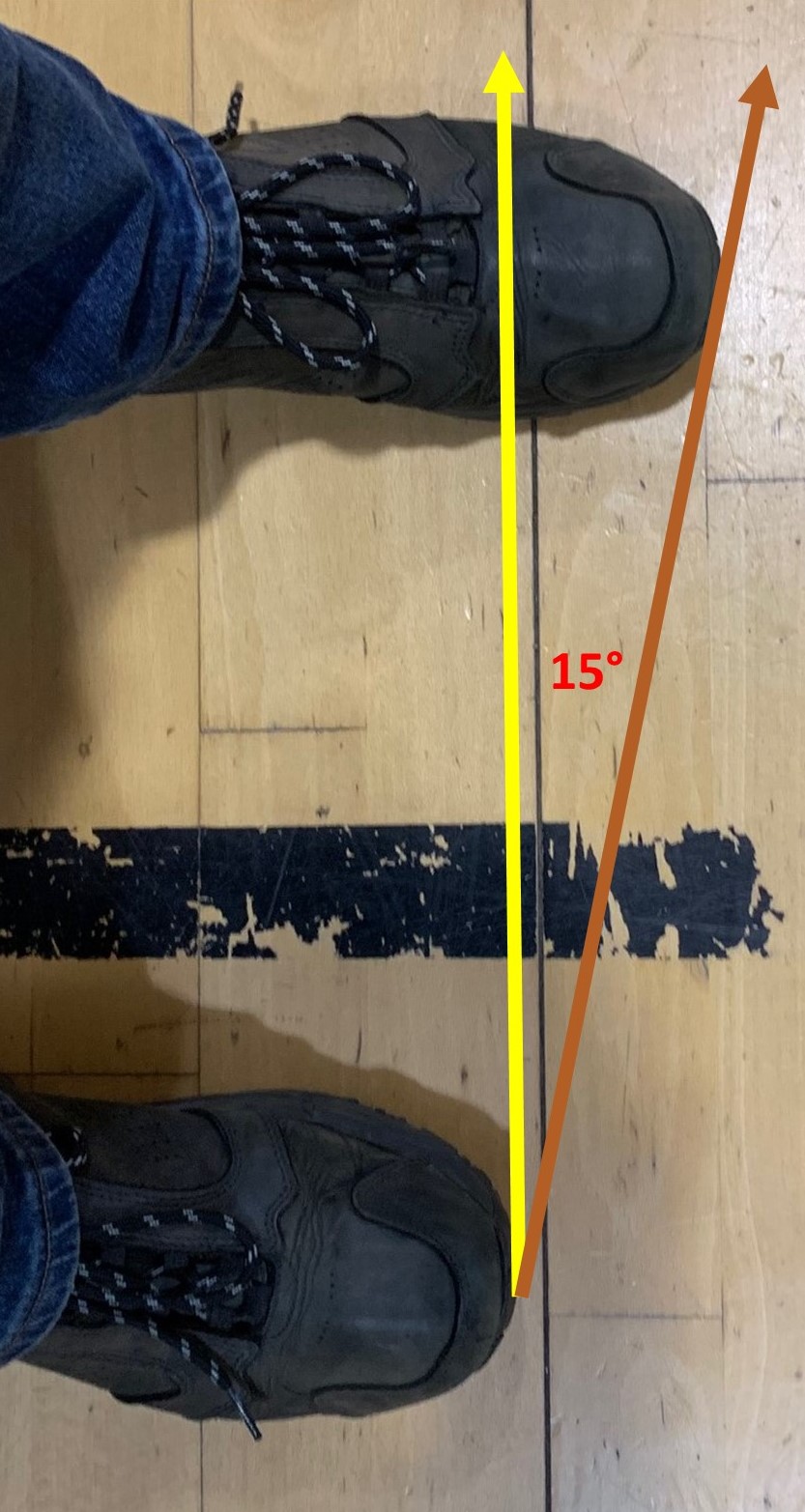
A 15° closed stance with the Yellow arrow pointing to the target.
Now some coaches use that muscle tension to create a more stable shooting platform to resist wind forces upon your body, for example. This, however, is an advanced bit of form which I leave to archers who achieve elite status. Then it is only to see if it produces better results. This bit of form has quite a pedigree. Back in his heyday, American Rick McKinney, multiple WC gold medalist, used an 80° open stance he called his “wind stance.” You can see it portrayed on page 23 of his book “The Simple Art of Winning.” (Steve has the image on his blog – take a look its halfway down the article with explanation. Its wild!)
I think there is too much dogma in archery instruction. In Compound archery, archers are taught that an open stance is normal. In Recurve archery, it seems almost to be required. It is not. In fact such dogmas erect blocks to better shooting.
For example: when I was still actively coaching I often encountered students who struggled to get to full draw. To address this problem I often asked them to adopt a 10-20° closed stance. Closed stances lengthen draws, open stances tend to shorten them. I got push back from students who thought an open stance was “required.” But getting them to full draw and much smaller groups was enough to get them to continue with the stance and good alignment. I always told them that once they got used to shooting while “in line” they could play around with their stance all they wanted . . . as long as they didn’t lose their good alignment.
Steve Ruis is the author of many books on coaching archery and maintains a blog for archery coaches at https://archerycoach.wordpress.com. He is the former editor of Archery Focus magazine.
* * *
Many thanks to Steve for writing this article for us. Our editor has yet to stop grinning.
Discover more from Glasgow Archers
Subscribe to get the latest posts sent to your email.