
The Pros from Seoul
 Glasgow Archers maintains a strictly “neutral position” on international archery. We would like to point out, however, that Korea is quite good at it. Here’s a reason why.
We all know that the Koreans are the Final Boss of World Archery. Any international archer who checks the brackets after competition ranking must feel the cold hand of dread on their spine if they see the Korean flag next to an opponent’s name. The competitive equivalent of opening a dungeon door and hearing the DOOM music. But how are they this dominant and terrifying? There are many reasons but today, we want to take a look at the domestic league system that produces the archery equivalent of the Terminator.
The Factory Floor
South Korea’s professional archery system is unlike typical commercial franchise sports leagues (like the NBA or Premier League). It is structured as a professional business team league system. So instead of private, profit-driven franchises, teams are funded and operated by local municipal governments, public corporations, state utility entities, and private corporations.
Some notable teams are Hyundai Steel, one of South Korea’s biggest steel manufacturers and a key affiliate of the Hyundai Motor Group; LH (Korean Land & Housing Corporation) who look after public housing and new town planning, and even the armed forces via Sangmu (Korea Armed Forces Athletic Corps) where male archers fulfil their mandatory military service by shooting for the team, so they can keep training while serving.
There are approximately 60 teams active in South Korea – very roughly 30 men’s recurve and 30 women’s recurve teams – showing their tremendous good taste in promoting the recurve bow. To be fair, they are expanding their compound infrastructure but challenging the US is proving hard work.
How to Manufacture an Archer
Unlike the Korean KBO league (baseball), which hosts centralized drafts for rookies, Korean professional archery operates through a direct recruitment and contractual scout model. Which sounds less like sport and more like something a management consultant invoices by the syllable. What on earth does that word salad mean? Let’s break it down:
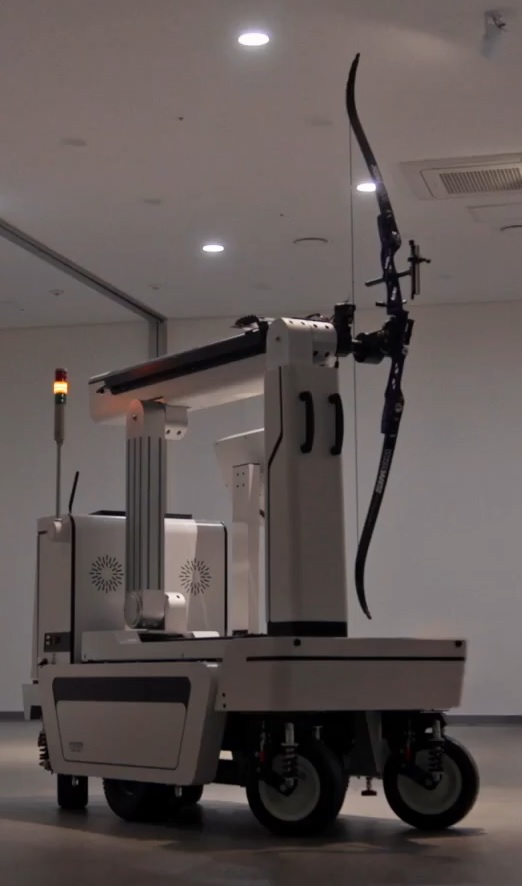
Even Hyundai’s robots get to experience the character-building effects of not making the team.
- Step 1: High School & University Pipeline: Archers are tracked from middle school through elite high school programs and specialized universities (such as Korea National Sport University or Keimyung University). There will be somewhere around 2000-2200 at high school slowly whittled down to 250 (via the thunder-dome of competitive archery) by the time they get to university. All prospective pro-archers are analysed and rated throughout these years.
Clicker issues and your rating will drop like a falcon in a power dive. - Step 2: How candidates are assessed and approached: Business teams directly negotiate contracts with graduating high school seniors or university graduates based on national rankings, youth trial performances, and physical testing.
Think NFL combine with more arrows, fewer vertical jumps, roughly the same amount of existential pressure. - Step 3: How teams compete for the best prospects: There is no randomized lottery draft. Teams compete to offer multi-year contracts and signing bonuses to top-ranked graduating prospects. In other words headhunting! Except instead of chasing strikers and midfielders, they’re chasing teenagers capable of shooting 700 on a WA 720 round before breakfast.
How Much for the Terminator Package?

I need your bow, your tab and your x10’s!
There are only 400 to 450 fully employed professional archers competing in the Korean business league circuit. These archers get full-time salaries and are officially hired as salaried employees. In other words, they are employed as Archers. The figures below are necessarily approximate. Detailed contract information is difficult to find publicly, so treat these as ballpark estimates (as at 2026) rather than a definitive salary structure.
Archers get a base salary + performance bonuses (based on national/international competition results). In addition they get equipment, world-class coaching, and access to dedicated archery facilities provided entirely by the sponsoring organization.
So what is the annual salary to do what our editor would give a kidney for? (note: not necessarily his own)
- A run of the mill mid tier archer earns ₩30,000,000 to ₩50,000,000 (£17k to £28k). While the base salary mirrors a standard white-collar office job in Korea, athletes have virtually zero living expenses. Housing, meals, training equipment, and medical care are fully covered by the team/organization. “Run of the mill” Korean … so still pretty damn elite!
- Elite / National Team Contenders earn ₩70,000,000 to ₩100,000,000 (£40k to £56k). Major corporate powerhouses like Hyundai (which has heavily invested in Korean archery for decades) or elite provincial city teams offer high-end athlete contracts. This is where Korean archery stops feeling like a sport and starts feeling like a very well-funded natural selection experiment.
- Olympic Medalists & Superstars earn a base salary + bonuses: ₩100,000,000 to ₩300,000,000+ (£56k to £170k). These are the Olympic gold medalists and world-record holders such as An San or Kim Je-deok. Note: the real income spikes come through incentives and prize money.
The Korea Archery Association (backed by Hyundai Motor Group chairman Chung Eui-sun) is famous for paying out immense bonuses. Like how immense? Individual Olympic gold medalists can pocket upwards of ₩300,000,000 (£170k) in association bonuses alone, plus additional lifelong monthly government stipends (called Sports Promotion Foundation pensions – Olympic gold £550/month, silver £420/month, bronze £300/month) and even local government rewards (which we assume means getting let off with your council tax).
No Rest for the God Tier

I didn’t make the team again!
It is a common saying in the archery world that winning a Korean national/business team event is harder than winning Olympic Gold. The depth of competition means world-record holders can lose in early rounds of domestic competitions. Every year, the national team selection resets from scratch; previous Olympic medalists get no free pass and must compete against fellow business team archers through grueling multi-stage trials. Win Olympic gold and the game doesn’t end, it just resets. Back to level one, same bosses, no saved progress.
This Nietzschean environment of intense struggle, personal excellence, and the overcoming of adversity is a key element of Korean archery’s supremacy. It is perhaps no coincidence that South Korea’s system keeps producing archers who seem unnervingly calm under pressure. After spending years surviving one of the most competitive sporting pathways on the planet, an Olympic final probably feels less stressful than a Tuesday afternoon at work.
Hopefully an article on their league system in detail will follow… as soon as our editor learns some more Korean. So far he only knows 기보배.
* * *
기보배 in Hangul (Korean alphabet system) romanises as Ki Bo-Bae … 2012 Olympic champion. Bo-Bae means ‘treasure’. Our editor has chosen his word .. wisely.
If you want to see Korean Ace Kim Woo Jin shooting against the robot .. you can see that here


Having those nice archery positions available in the corporate leagues helps keep the younglings at practice. Here in the US It is bloody difficult making a living as an archer, so many hours that could be devoted to practicing are devoted to working a job.