The Great Arrow Tuning Mystery: A Tale of Wobble and Woe

New Arrows WOOHOO! .. but now I have to tune them. Oh lord please don’t hurt me now!
So there you are. You’ve just bought yourself a shiny new set of arrows. The shop assistant assured you they were “perfectly matched to your setup” and you nodded sagely as if you understood what that actually meant. You get them home, eagerly slap on some fletches mibi even in club colours if you’re feeling fancy, and head down to the club for your first shoot with your shiny new projectiles. Then… chaos.
The Problem: Your arrows are doing things that arrows really shouldn’t do. Most seem to be heading to the right like they are trying to escape to Edinburgh. Another decided to dive into the grass like a gannet after a fish supper. Was that one on me? Did I drop my arm? Collapse my shot? Meanwhile, that one arrow – you know the one – is sitting in the gold, mocking all its siblings for their terrible life choices. Is it the arrows? The bow? Me? Help!
Welcome, dear archer, to the wonderful world of arrow tuning. Or as we prefer to call it: “Why Does This Stupid Sport Hate Me?”
What Actually IS Arrow Tuning?: In theory, arrow tuning is the process of ensuring your arrows fly straight and true, like feathered projectiles of perfection. In practice, it’s more like trying to negotiate a peace treaty between your bow, your arrows, your technique, and the laws of physics (spoiler: physics always wins).
The goal is to get your arrow to leave the bow cleanly, flex just the right amount (yes, arrows are supposed to bend in flight – physics be weird), and recover quickly enough to hit where you’re actually aiming rather than where the archery gods feel like sending it today.
The Spine of Contention: Here’s where it gets properly mental. Every arrow has something called “spine” – which is basically how bendy it is. Too stiff for your bow and your arrow will fly like a telegraph pole. Too weak and it’ll wobble about like a boiled noodle in a hurricane. Getting the spine right for YOUR setup is like Goldilocks finding the perfect porridge, except with more maths and considerably more swearing.

May as well be in ancient Etruscan for all the sense it makes!
Your required spine depends on:
– Your draw weight (how heavy your bow pulls)
– Your draw length (how far back you pull)
– The weight of your point (the sharp/blunt bit on the front)
– The length of your arrow (based on your draw length)
– Whether Mercury is in retrograde (ok, mibi not that one)
Spine charts exist to help you figure this out. They are complex, contradictory, and different for every manufacturer because why would anyone want to make this easy? THIS .. IS .. ARCHERY! Nothing is ever easy.
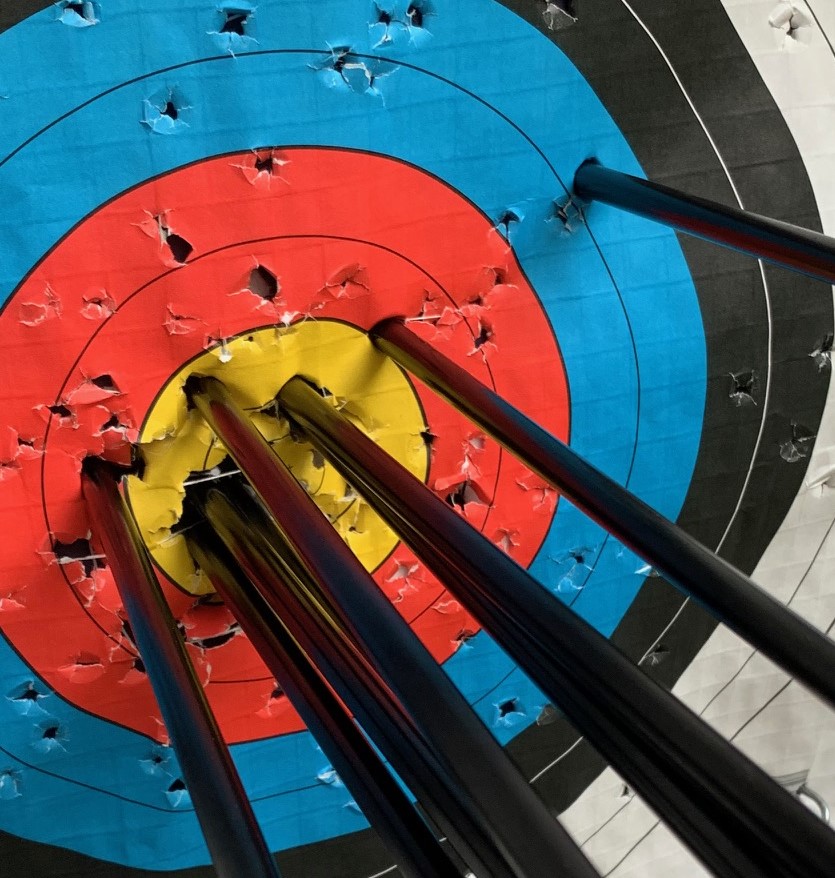
WOT IS YOU DOING OUT THERE YOU ‘ORRIBLE LITTLE BARE SHAFT. GET IN THE MIDDLE LIKE ALL THE OTHERS!
The Bareshaft Test: Or How I Learned to Stop Worrying and Love the Wobble: The traditional way to tune your arrows is the bareshaft test. This involves shooting arrows with no fletches (hence “bare”shaft – we’re very literal in archery) alongside your normal fletched arrows to see what’s happening. If your bareshaft lands to the left of your fletched arrows, that means… something. If it lands to the right, that means… something else. If it lands in roughly the same place, congratulations! Your arrows are tuned! .. Or you’re shooting so badly that nothing matters anyway, but let’s be positive. The problem is interpreting the results and based on that, every archer you ask will give you different advice:
– “Adjust your nocking point!” suggests one.
– “No no, change your button tension!” insists another.
– “Tried sacrificing a goat?” says a third (we don’t let that person near the beginners anymore).
The Field Solution: Of course, all this technical wizardry assumes you have the consistency to actually tell if it’s your arrows or your shooting that’s the problem. Spoiler alert: at the field on a windy Wednesday evening when you’ve not shot in a fortnight and you’re distracted by Captain Sausage’s loud Tourette’s inspired expression of hatred for archery, it’s probably your shooting. But here’s the beautiful thing about arrow tuning – once you get it right, it stays right .. that is until you change literally anything about your setup, at which point you start all over again. When you do finally crack it, when those arrows start grouping like they’re magnetically attracted to each other, when you can actually blame your bad shots on YOUR technique rather than your kit… that’s a special kind of satisfaction. That, or you just buy a compound bow with enough gadgets to compensate for any tuning issues. (We’re kidding, we’re kidding! .. mostly ;o)
Practical Advice (Yes, Really): If you’re struggling with arrow tuning, here’s what actually works:
-
- Ask a coach or experienced archer. Seriously. Michael’s forgotten more about arrow tuning than most of us will ever know, and he’s usually happy to help (especially if you bring biscuits).
- Change one thing at a time. If you adjust your button, your nocking point, your brace height, and your draw weight all at once, you’ll have no idea what actually fixed (or broke) things.
- Accept that “good enough” is actually pretty good. Unless you’re shooting for Scotland, having arrows that group within a couple of inches of each other is fine. Perfect is the enemy of done.
- Remember that the best arrow tuning in the world won’t help if your anchor’s wandering about like a lost tourist in George Square. Sort your form first, THEN obsess about equipment.
- When in doubt, blame the wind. It works for the rest of us.
You can trust me .. I’m an archer!
The Truth About Arrow Tuning: Here’s the secret they don’t tell you in the archery magazines: Most arrows, if they’re reasonably close to the right spine for your setup, will shoot well enough. The difference between “adequate” and “perfect” tuning might gain you a few points over a full outdoor round… but fixing that collapsing bow arm will gain you 20! Arrow tuning is important. It’s also a fantastic displacement activity when you don’t want to admit that the real problem is standing behind the bow rather than being shot from it.
But for those magical moments when everything comes together – when your form is solid, your arrows are properly tuned, and the Glasgow weather gods are feeling merciful – archery becomes this impossibly satisfying combination of zen meditation and precision engineering. That, or your arrows still end up in the grass and you spend ten minutes crawling about on your hands and knees trying to find the one with the patriotic blue and white fletches before someone stands on it. Either way, it’s never boring being an archer.
* * *
– Got arrow tuning questions? Catch one of our coaches at club night. They’ll either solve your problem or at least commiserate over shared tales of tuning trauma. Misery loves company, after all!
– Read about arrow tuning from the experts .. Easton. Try their Arrow tuning and maintenance guide and we’ll write a more serious article on tuning in the new year so come back for more archery wisdom .. and the occasional questionable life choice!
– Shark image by Gerd Altmann from Pixabay
Discover more from Glasgow Archers
Subscribe to get the latest posts sent to your email.