Are You A Confident Archer/Coach?
Coach Ruis is back with us this week addressing confidence ... as if any of us had any of that! ;o)
 When I watch sporting events on the telly (fine use of UK slang), the commenters usually say at one point that confidence is very important to performance. A basketball shooter makes a couple of shots and becomes “more confident” and thus more effective, etc. A golfer sinks a long putt and becomes more confident, sinking even more long putts.
Is that really the case?
Confidence is studied by scientists and scholars and there seems to be a budding consensus that the source of a person’s confidence is 50% nature and 50% nurture. That is some of your confidence is inherited, some of it learned.
Since you have no control over your genes, you can’t worry that you haven’t inherited enough confidence . . . well, you can, it just won’t do you any good. You can, however, build more confidence through experience. For archers, good performances build confidence. Poor ones reduce it. This is, I hope, obvious. However, any number of pro golfers, including all-time great Jack Nicklaus for example, point out that confidence is slow to build up but can be lost very quickly.
Build It and . . .
So, how should archers go about building their confidence? Since we are talking about performing well and recognizing it, I am going to argue that goals provide us with a ready-made tool to do this. I am going to recommend that the best goals to use for this task are process goals. Outcome goals are useful . . . but. . . .
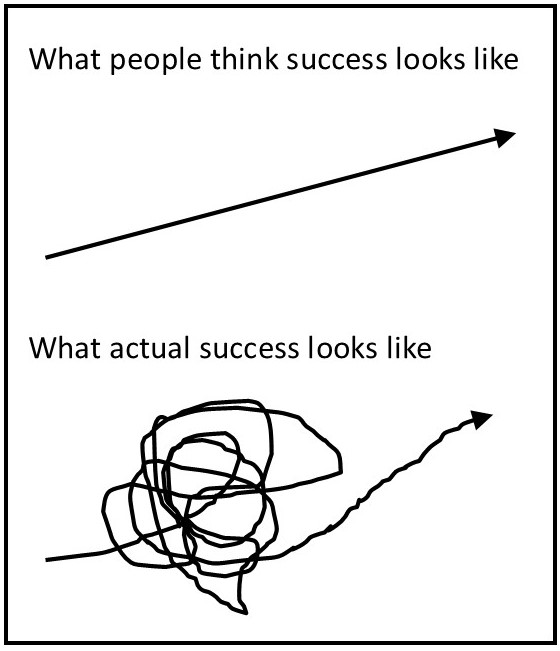 I have told the story often enough, but it applies here. I had an outcome goal of shooting a perfect 300 on an NFAA Indoor 300 Round (60 arrows, 5-4-3 scoring, 12 5-arrow ends). Over more than a couple of indoor seasons (we only shot this round for half of the season, the Vegas Round for the other half), I clawed my way up to an average score of 296/300, then 297/300, then 298/300, but I never hit the magic score of 300/300. I can remember having to struggle to not think about missing. Then it happened, 300/300 (42X)! Ta da! I was finally a 300 archer! I made it! And my next round was a 286/300. I thought my struggle was over and 300 scores would flow like fine wine. Of course, it was the struggle which got me there and giving it up . . . well, you know.
Outcome goals are iffy at best, but process goals! Process goals get you to focus on what makes for a good score and avoids focusing on the scores as you go. An example might be, “I will execute my full mental program on 95% of my shots.” The easiest way to do this is to take a page in your notebook (the small portable one you carry with you), list the end numbers down the left hand edge, write the process goal at the top and then after each end, as you are walking to the target for scoring and pulling, write tick marks for each shot you met that goal on. So, if you did it on all five shots, five tick marks. (Don’t write the number “5,” write five tick marks (✓✓✓✓✓). This helps you recall each shot individually so your count is accurate.) Before you put the notebook away, read the process goal again (it is easy to lose track of what you are to be focusing on, so reinforce, reinforce, reinforce).
At the end of the Round, do the calculation to see if you hit the 95% mark. If you fell way short, possibly your goal was set too high. Set a lower percentage, one you can meet, remember we are trying to build confidence, as in I meet my goals” confidence. Once you have met such a goal a couple of times, then raise the bar a bit and keep going. Obviously, I hope, you want to shoot good shots 100% of the time.

when the wife asks how I did tonight ... I'm just telling her how many 10's I shot.
Drills, some at least can build confidence. I recall a drill recommended to compound archers chasing perfect scores, as I was doing in the example above. The drill starts with a very large target face (your choice) up very close (again your choice. You shoot ten arrows and a perfect score is needed. Three perfect scores in a row and the target is moved back five paces, rinse and repeat. If the target gets back to the official target distance for the round being worked upon, say 18 meters for indoor rounds, then the target face is swapped out for the next smaller size, you go back to the closest distance and repeat the process. Various levels of difficulty can be injected by adding penalties for misses. At first a miss requires the round to be started over. Later, a miss can require a restart on the “three perfect scores in a row” being worked upon. A “big hammer” can be, a miss requires going back to largest face, shortest distance to start the entire process over again. The idea is that you reach the official target face at the official distance shooting perfect scores. (You can adapt the goal to less than perfect scores or anything else.) The idea is by the time you have worked through this whole thing, you will have shot thousands of “golds” or “spots” or “Xs.” In your mind, hitting the gold is now normal for you. You have the results to underlie a new level of confidence. (Your brain doesn’t quibble that you started shooting at an 122 cm face at ten meters, a gold shot is a gold shot.)
Confidence shows up when you have a task and you know you can perform it, not just “I think I can” or “I will give it a try,” but “I know I can.”
* * *
“Confidence comes from evidence. If you want to be confident about something, put in the reps and give yourself the evidence.” — Brad Stulberg, author of The Practice of Groundedness.
Steve Ruis is the author of many books on coaching archery and maintains a blog for archery coaches at https://archerycoach.wordpress.com. He is the former editor of Archery Focus magazine.
Discover more from Glasgow Archers
Subscribe to get the latest posts sent to your email.