One of our Arrows is Missing!
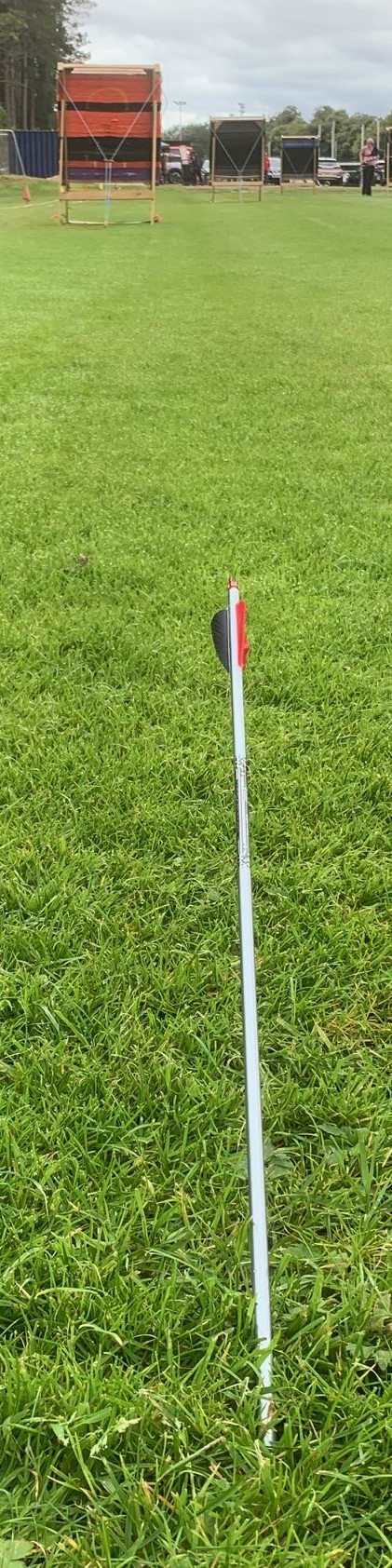
I think it went a little bit over!
With a new outdoor season just around the corner and us moving to a new location, we thought it prudent to raise that bane of every archer not of international standard or Korean .. an arrow in the grass!
It's inevitable that archers will miss the scoring bit of the target on occasion - admittedly some more than others. Usually the wooden frame or stand magically catches the arrow and we need to get the Arrowjac or a big screwdriver to pry it out the wood. Indoors, if you miss all of the above, we have the back curtain to intercept the wayward shaft. Outdoors, its in the grass and then the fun begins because it might not be visible.
However, before we get started on today's subject matter, there's a couple of things you need to consider as an archer shooting outdoors ...
Awareness: Archers should always be aware of where their arrow is going. If it doesn't hit the target somewhere visible, you should know if it's left or right, long or short. If you don't, you just made everyone's job of finding your arrow 10 times harder and will take a lot longer to find impacting shooting for everyone .. so be aware of your arrow in flight and always be prepared to give us short/long - left/right starter for ten.
Conditions: The condition of the ground makes a big difference to potentially losing an arrow in the grass. When the ground is holding a lot of moisture (as it does in Scotland A LOT for you furriners ;o), the arrow tends to dig in point first and stick up in the air making it easy to find (like in the picture to the right). But when the ground starts to get firmer in that mythical period known as a "dry spell" or the rare as a unicorn "summer", arrows don't stick in quite the same. The point hits and deflects parallel to the ground at increasingly shallower and shallower angles as the ground gets harder till it eventually loses itself in the grass roots. Even where the grass is short, the arrow will disappear from view and short of getting a lucky spot on a garish fletch/wrap … its metal detecting time.
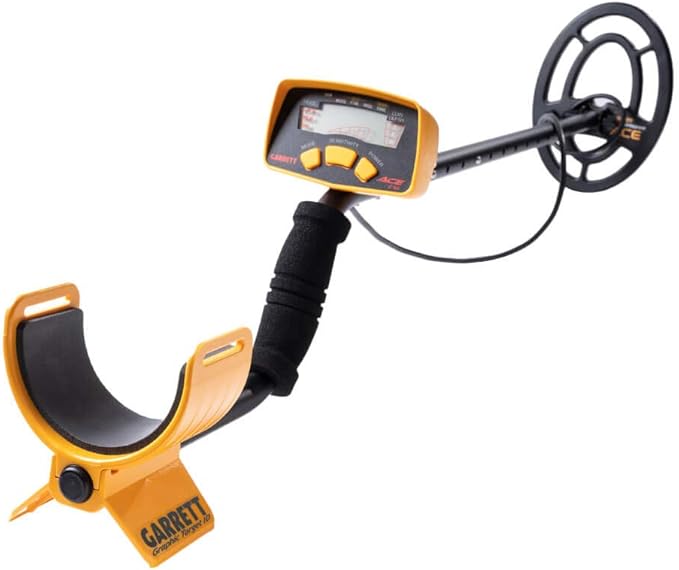
The Garrett ACE 150 is well named
Its something that everyone should know how to do but some people are better at it than others. These are the legendary Arrow Ferrets whose skills at finding arrows are rivaled only by Oksana's ability to find the ten ring. GA has two pretty good detectors of a model that have done the job for many many clubs around the country for decades. As an overview on how to use them, here's a rough guide in how to go about detecting pointy things in the shrubbery ..
The detector should be turned on and set to a depth of 4" - a medium sensitivity. That will allow for longer grass/uneven ground but should always be close enough to get a return signal. Adjust the head so that when you sweep, the head is parallel to the ground. Walk forward slowly in a straight line, slowly sweeping as you go. Too fast and you detect nothing. Be methodical. The head should skim the ground as close as possible. As arrows tend to be around 28" long, adjust your sweep to cover every 18 inches to 2 feet (45-60cm) or so ensuring you could potentially catch at least part of the arrow each sweep. You should test one of the missing arrow's quiver mates to see what the detector registers. In the main, Aluminium's show up as PTAB (an alloy) and A/C carbons show up as IRON/NICKEL. All-carbons with collars show up intermittently and may not fit to any rule of thumb so definitely worth checking what signal you get back from them to be sure. We can't shoot all-carbons outdoors without the metal collars front and back for fear we cant find a lost one in the grass due to the low level of metal.
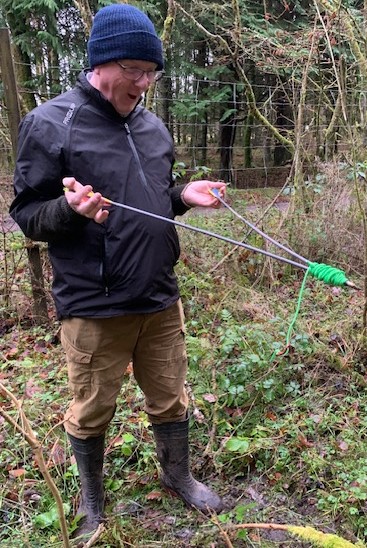
John trying an alternative approach.
The most annoying thing you can get while sweeping is false positives. This is where there's something else in the ground the detector is picking up like drainage pipes, buried metal studs, pirate treasure, John's keys etc. Its not an arrow but you still get a signal. What you are looking for is multiple positives of the correct materials as you sweep back and forth across the arrows direction of flight. This will indicating a larger contact. If you get a positive, and its coins or rings or something other than what the test arrow showed .. these can be safely ignored. If its the materials you are looking for, start a focused search over the area where the ping happened. Was it just a random positive or were there multiple hits? A quick finger search of the noisiest area will revel the arrow or lack thereof. Usually a helper can be brought in to do the actual probing saving your aching back - sweeping do be painful.
Finally don't bring two detectors close together. They start detecting each other's signals and will go "totally tonto" in the Glaswegian vernacular.
Now for the blood curdling bit .. we cant leave the field til we find ALL missing arrows. Losing an arrow on a multi use field is as close to a club ending disaster as you can get. Last year we instigated a register of arrows being shot every outdoor session because someone lost an arrow on the field and left without saying anything. That nearly ended the club. A loss like that won't be happening again without us knowing and we will be running the register again this summer so check your arrows at the door both arriving and departing!
Outside of the above its just practice til you can predict the likely area to investigate then sweep methodically till a successful conclusion is reached. That way we can all get back to doing what we came to the field for ... drinking caf, bitching and planning our next purchase of shiny things ........ oh yeah, and shooting!
* * *
GA got its first metal detector in late 1961 ... We know this because its mentioned in committee minutes after our move to Cartha Rubgy Club but they referred to it in its pre-hobby terminology ... a mine detector!
The Garrett 150 Metal Detector ... saving archers arrows for decades!
Discover more from Glasgow Archers
Subscribe to get the latest posts sent to your email.