
Wrist in Peace
How you grip your bow is one of the great evolutions of your archery. As a noob you are grabbing that thing like its an annoyed cobra and if you let go of its throat, its going to bite you. This causes all kinds of torque issues. As you evolve your style, the hand relaxes becoming a softer, more forgiving interface between archer and riser BUT becomes more prone to random variables sneaking in. We've spoken of string picture being a way to control left and right torque in your wrist. However, what about other axes? (that's the plural of axis honest! - ed) Well, that's todays subject so we're going to focus on your actual contact with the riser. This is all about the handle of the bow and how you orientate your wrist to it via the grip.
There are various degrees of your grip but lets talk about the two extremes .. the High and the Low wrist grip. Which you chose affects the pivot point - where the webbing between thumb and forefinger goes at the top of the handle .. and the pressure point which is where your hand is in contact with the handle.

High position handle brings the wrist up.
Higher Wrist Grip: Here your wrist stays much more upright with the grip angle being 45° or more from the vertical. The back of your bow hand is more aligned with your forearm, and the wrist is slightly flexed upward. The contact point with the bow grip (pressure point) is higher on the palm, often near the base of the thumb, with minimal heel pressure. This is the preferred grip of Olympic style recurve archers .. i.e. most of our club .. for its consistency.
There are more advantages to this sort of a hand position as it tends to be a little more forgiving of minor hand torque or pressure inconsistencies. Ideal for the noob. It can also encourage a more relaxed hand which every archer strives for. However it can cause the bow shoulder to rise if not managed carefully during the shot. That's the infamous hunching of your shoulder on its way to your ear if you are struggling to pull through the clicker or to anchor. You may also feel a little less stable if your core and upper body aren't particularly well engaged.
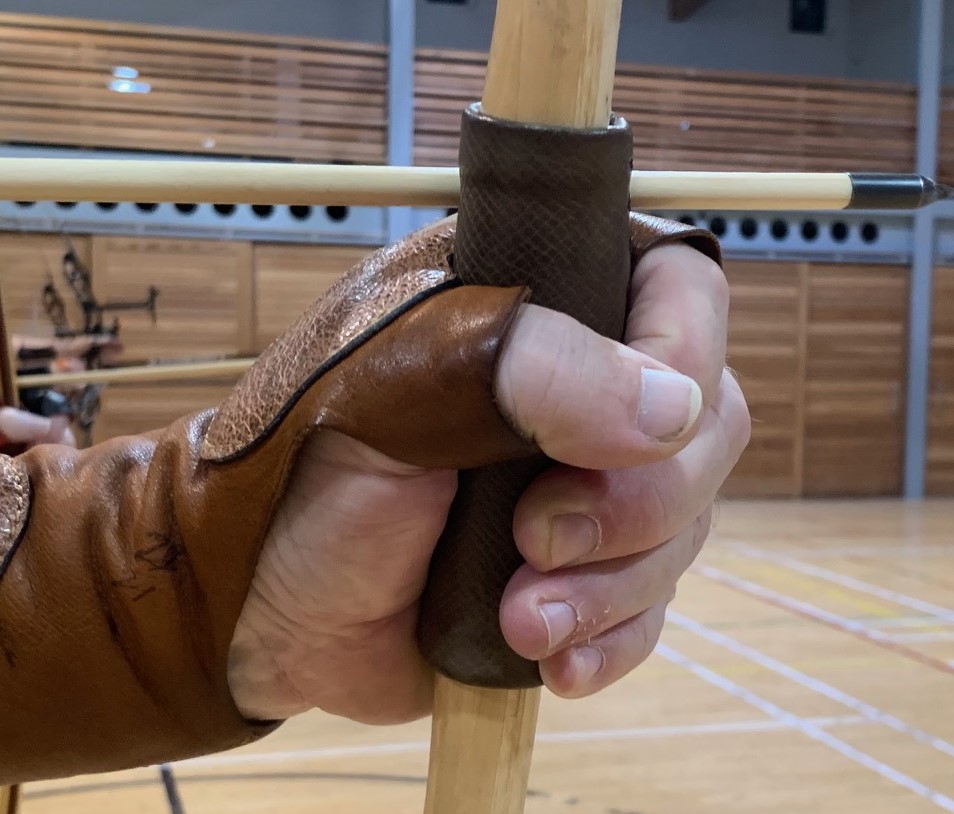
No handle on the longbow stave .. so low wrist position.
Lower Wrist Grip: Here its a flatter grip angle (30° or less) and the wrist sits lower.This means the back of your bow hand is angled downward, with the wrist slightly extended. The pressure from the grip is transferred more into the base of the thumb and the meaty part of the palm (aka the thenar eminence for you medical types), rather than across the full palm or into the fingers. Think of your hand being raised at the wrist and locked back. Often used in traditional styles where the longbow stave or the horse bow has no handle. And infamously in the compound which has no handle either and you are gripping onto the bare metal of the riser. (yes, that can be chilly in winter). .
This approach does sort of solve the bow shoulder hunching as it locks the bow shoulder down, promoting better alignment. It can also feel more a little more natural for archers with strong shoulder engagement. (lovely pair of shoulders there .. show them off show them off) The down side of this is it can be a little harder to keep pressure on the hand steady which can amplify any torquing problems left over from those days of gripping the handle. It is also a bit more of a struggle to get that hand relaxed which exacerbates issues of the handle slipping although that can be gotten around with taping the handle. (We'll cover this in a later article).
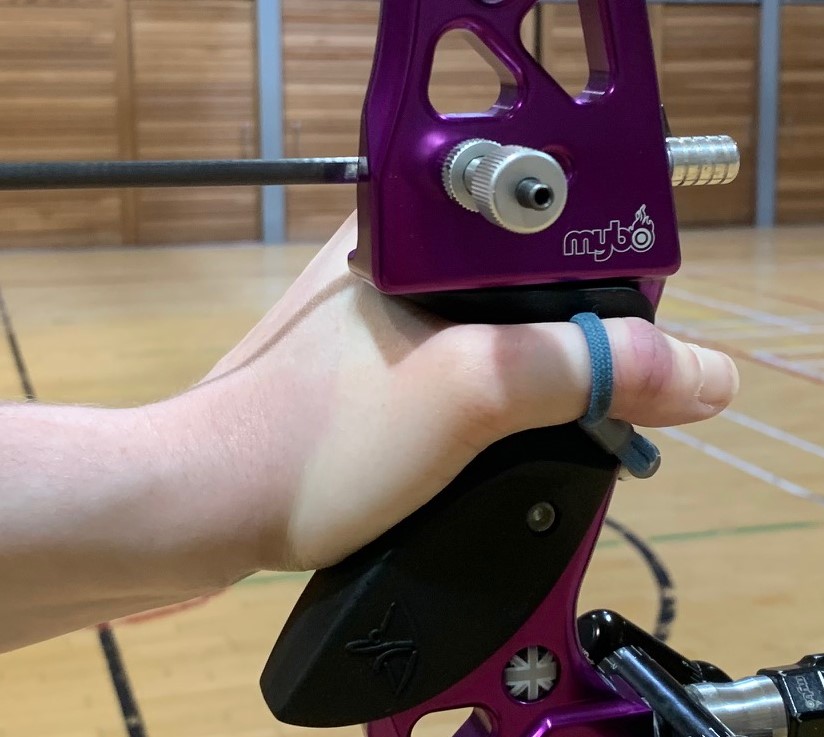
This handle has a steep downward angle resulting in a lower wrist position
Handles: To support your new hand position you really need a handle that lets you bed your wrist position in. Now while every recurve bow comes with a handle, its usually a fairly generic grip in the middle ground between high and low. Depending on the riser, it may be a soft synthetic "rubber" like material or possibly the classier (if slippy) wooden. It is possible to replace handles depending on the bow, riser manufacturers and third party businesses do make replacement handles. Here you can pick the handle shape/material you like and have at it. Companies like Win&Win and H*yt usually have modified handles for sale as extras. Geo got one from Korea in less than 3 weeks. Alternatively there are 3rd parties making handles. Just be careful if you do go down this route as generic handles from 3rd parties aren't always a great fit. Custom made tend to be a better fit but can be a little pricy. RCore are probably the best known of the 3rd parties with a reasonably good reputation supplying wood, glass like and plastic grips.
Alternatively make your own. Get a generic replacement handle for your bow and rebuild it using epoxy putty. There are numerous videos on the subject and making your own handle is definitely a flex on your fellow archers. Jake Kaminski, all round font of archery knowledge, has a video on the subject to be found here. To some the perfecting of their handle is a hobby all on its own and are forever shaping, filing and tinkering with their master work.
So there you go. Yet another thing to obsess over in your archery. For GA folks, key members to look at in the club are Wee Dave's barebow (shot handle less). Any compounder (hand straight onto the metal riser). Geo's Win&Win wooden high wrist position handle and John's RCore wooden handle believed to be high wrist but with John who knows!
* * *
Extra GA credit will be awarded to anyone who can identify the above GA members from their hand model portfolio pictures.
Mr Kaminski goes into more detail about high/low grips in this video
Discover more from Glasgow Archers
Subscribe to get the latest posts sent to your email.

1 Response
[…] places: Your hook on the string, and the handle on the riser. We’ve talked about grips before — whole articles, diagrams, the usual descent into madness — but this is a Hot Fix, so we’re ignoring everything except one problem: slippery […]