
The Downside of X10 Ownership
 The ultimate recurve competition shaft. The Easton X10 has won more World and Olympic titles than any other arrow – or any other archery product of any kind – since its competition debut at the 1996 Olympic Games in Atlanta, USA. – Easton Archery
There is something about the gold* standard X10 that is like a siren call to archers who have been in the sport for a while. An iconic piece of kit shot by the very best. What archer wouldn’t love to have a set in their quiver? We are all about the shiny toys are we not? But while the X10 is the unicorn, representative of every archers dream, where they clasped their hands together and tried to wish it into reality .. There is a dark side to ownership of the X10 that no-one ever talks about. Til now … ;o)
Cost: Lets start with the biggest impediment to X10 ownership. X10s are considered a top-tier arrow and their price reflects their “status”**. Lets be honest, these things are extortionate. The shafts alone are £400. Then add in stainless steel points, nock pins, nocks and fletches and you are talking north of £450 for 12 arrows. That’s more than our half Aberdonian (legendary cheapskate) editor paid for his entire first bow, arrows and kit! Don’t even get us started on the Tungsten Break-Off Points you can get for X10’s coming in at £240/dozen! NO beginner or even intermediate should be thinking about these arrows where Alimax or Parallel Pro’s are a much more forgiving and cost efficient purchase. Even intermediates are not going to get a lot of love from these things if they klutz a release. So while these are fantastic arrows, consider a parallel shaft which will be a good performer but not be so impactful on your wallet..
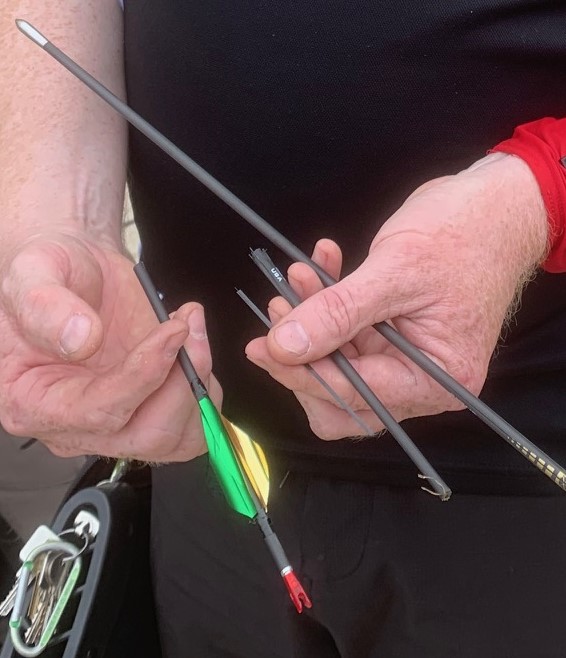
It is an Ex-X10 ……. It has ceased to be!
Fragility: The small diameter/surprising weight of the X10, is fantastic when you consider aerodynamic benefits being less affected by crosswinds. However the fineness of the components makes them more susceptible to damage during assembly, disassembly, and shooting. So care has to taken when using/building these things. They aren’t keen on being roughly handled, shot into wood or clashing with other arrows in the target. So check those arrows for cracks on a regular basis. Putting the things together especially on the lower spines is a real nightmare due to the really tight tolerances Easton achieve. However this perceived frailty we just mentioned is only for handling, construction and normal shooting. What happens when its something more extreme?
Not Consumables: One of the first things we tell new archers is their arrows are ammunition. They are consumables in that they can and will get “expended” i.e. broken. It prepares them for when the edge of a boss intersects with their arrow shaft and the back end decides its going solo from its very successful duet with the front end. This inevitability of arrow damage does not carry through to X10’s in the experienced archers mind. X10’s are forever. Owners of X10’s are, in the main, good archers. They don’t (often) have accidents were their arrows get bent, bisected or exploded. They certainly don’t expect a central bank sized financial crisis in a single shot. This can lead to quite a bit of trauma for the archer whose X10 does pass on to the great range in the sky in spectacular fashion. If it happens twice (due to a dodgy sight mark), expect a tantrum that would make Operatic Divas envious.
Lost: Where a smashed X10 brings sadness, anger and depression, a lost X10 brings panic and irritability like you wont believe. Its bad enough putting an arrow into close cut grass where the A/C nature of the arrow allows the metal detector a good chance to find it quickly .. but putting one into a field course forest floor? Eeeek! With leaves, fallen branches, knee high grass, rhododendron bushes the size of artics, this can lead to the archer going all snarly boi even to the people trying to help them find their arrow. That’s £40 they’ve just lost in the shrubbery and Murphy’s Law will almost certainly have the arrow no-where near where you think it is. Expect to be searching for this arrow for a long time/till found – the owner will not be giving up any time soon. So if this is a potential scenario you might face, remember to pack your arrow ferret.
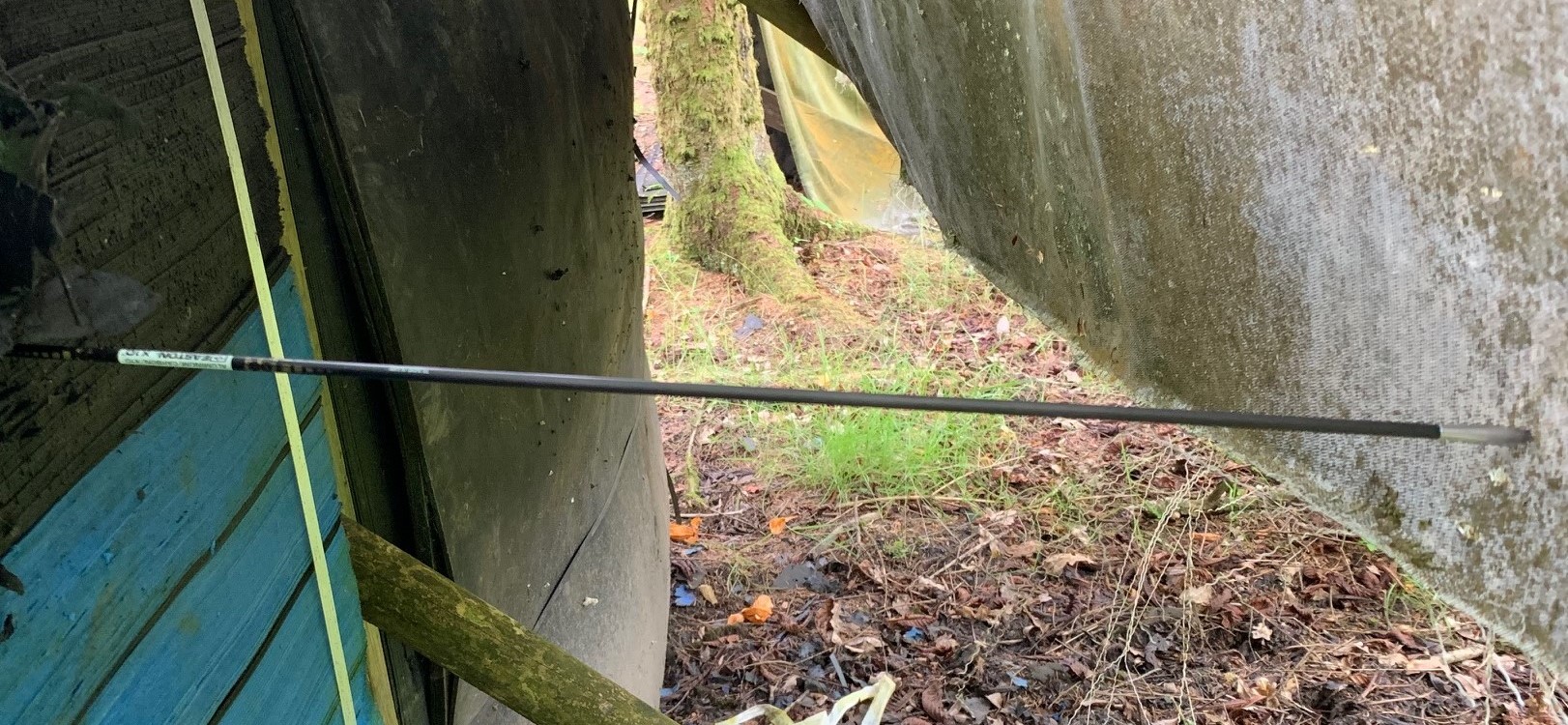
You might want to stop using so much arrow lube!
Momentum: Due to their smaller diameter, comparatively high weight and potential for higher momentum, X10s have a tendency for pass-throughs or impressive penetration. These arrows hit hard and focus that hitting power in a much smaller point on the boss than, say, an ACC or aluminium. We’re not saying these arrows are armour piercing, but they don’t transfer energy efficiently to what they hit nor do they generate much friction due to lack of surface area. So like the energiser bunny, they keep going and going. This can be a problem on shot out bosses (less material to generate friction) or when the targets contain a lot of moisture (lubrication) since these puppies do not slow down quickly at the best of times. It’s even more of a problem if you hit wooded frames where the arrow is going to drive in pretty deep. With X10’s arojac‘s can be a necessity, not a luxury. You also better hope the person building the arrow wasn’t frugal with the hot melt.
Finally Tuning: These arrows are not very accommodating to sloppy form (beginners and intermediates beware) and this is exacerbated by them being tricky to tune. Their barrel shape means you are limited in how much you can cut off the front .. and extremely restricted in what you can cut off the back. Top-end barrelled arrows like the X10 commonly have a maximum trim amount. These trim amounts generally vary from spine to spine. The trim limitations make sure the arrows aren’t cut into the actual barrelled zone. If this happens, the shaft will be wider than the shoulders of the point. This will leave the exposed carbon proud of the points, which will certainly get damaged. As the shafts are non linear, changes to the shaft are not always predictable. X10’s also need not perform well based on your poundage as its said that the arrow’s flex needs around 37lbs or better to make it perform to Easton’s predictive model. How this affects lower spined arrows is a question for Easton’s George Tekmitchov.
The X10 is definitely one of those iconic pieces of archery kit .. be it for its spectacular record in the Olympics, the recognizable names who shoot the things, their insane engineering tolerances or their wallet damaging cost. As such, archers are going to lust after the things but archers whose wallets might be bigger than their ability could suffer a lot of frustration shooting X10’s. After all, you wouldn’t want a learner driver to be driving a Ferrari. Shoot something a little more forgiving till you’re confidently smacking that gold at all distances. Then the X10 will be your bestest bud .. but till that point expect them to be real frenemies the second you give them any latitude to mess with you.
* * *
* GA Fact Check: A single X10 would cost approximately £40ish (if you could buy them singularly) – £60 with a tungsten point .. Equivalent arrow weighing 22.5grams (350 grains) but made of 22ct gold = £1,800 so not quite costing their weight in gold .. yet!
** A premium price strategy involves setting a product’s price higher than competitors to convey a sense of superior quality, exclusivity, or luxury. Strong branding and marketing efforts are used to justify the higher cost and attract a specific target audience that values these perceived benefits. i.e. archers in search of expensive shiny things that magically will “improve” their shooting.
Discover more from Glasgow Archers
Subscribe to get the latest posts sent to your email.


Well written article, they are well out of my ability range…and budget 😀
Another piece of kit designed for elite performers then sold to anyone with a credit card.
The competitive advantage to X10s is so small only elite archers would see it, so why waste your money? I still think the ACE is a premier Recurve shaft (even compound) for about half the price and there are many other options. If you keep near every damn thing you have bought, you may still have your “old arrows” in numbers that are testable. Do a competition between the two arrows. Shoot one, then the other at the same target, set at a mid distance. You will get two groups because it is near impossible for the bow to be set up equally well for both. Measure the group size of the two arrow types. Repeat the test if you find the results odd.
I think you will find the results surprising in that “new and improved” is often just “new” … and more expensive. I did a similar test when I first started shooting indoors. I shot my outdoor setup with skinny arrows (ACCs) but was encouraged to shoot “fat shafts,” the argument being the fatter arrows would catch more points (outside in scoring). The test I did was to take my ACC target home with me and then I took a small segment of a fatter shaft and placed it over each arrow hole to see if I would have gained points had the fatter shafts been shot in the same holes. On a 60-arrow round (300 points) I picked up between 1 and 1.5 points per round. If a 30-arrow WA round had been shot, that would have been half that much. Of course, I wasted a great deal of time and money trying fatter shafted arrows. When I saw that Michele Frangilli had set a new WR in the 25 m indoor round … shooting ACEs, I realized the “common wisdom” of shooting fatter shafts indoors was not quite wisdom, unless you were looking for that elusive 1-1.5 points per round.