
Four Things you might not know about Barebow
 Barebow is not just recurve without the extra bits. Its a very different discipline to its more peripheral-ised cousin and as such can cause absolute havoc to anyone picking up barebow straight after their beginners course. Lets look at four barebow characteristics that fly in the face of that very inclusive beginners course you just came off... (experienced recurvers - you brace for weirdness).
Weighting Barebows:
When adding weight to a barebow its common just to stick a big weight into the bushing just under the handle at the front. Indeed, most of the barebow specific designs build this feature into their bows. This pulls the centre of gravity down balancing the bow on release, increases inertial thus aiding stability and makes your arrows sound quieter - less hand shock. But there are other ways to balance a barebow.
As an alternative, split your weights over all the bushings including those close to the limb pockets. This spreads the weight over the bow improving inertia across the entire bow at the moment of release and reducing the bow's desire to rotate/torque about the central weight. Just be careful not to over do the weights. This is as recommended by international archers. We didn't just make this up .. honest mister!
Tiller:

Red lines indicate top and bottom tiller
Tiller refers to the difference in distance between the top and bottom limbs of a recurve bow from the string when strung but not drawn. Essentially, tiller is about ensuring both limbs are working in sync to deliver a consistent arrow flight so its a crucial adjustment for your shot. Normally recurves have a positive tiller - the distance between string and bow at the lower limb bolt is smaller than that at the top of the bow. Usually by about 4-6mm (ish).
Barebow turns this on its head because of the hook & crawl on the string. This is because to aid in aiming, barebow archers often hook well below the nocking point. This overloads the bottom limb and can be a little uncomfortable on the fingers. To better balance the bow, barebows go with a negative tiller where the string is 4-6mm FURTHER from the lower limb bolt.
Once set up it will be invisible to you but it is something to remember if handing your bow to a recuve-o-centric archer to rough tune. He won't know the trick.
Stiffer Spine:
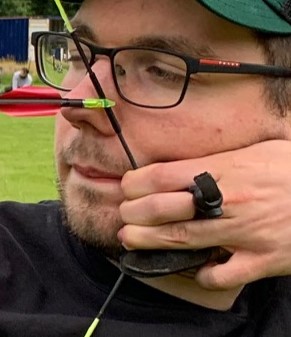
a pretty extreme crawl for a close target
When choosing arrows, normally you work out your draw length, identify your bows draw weight at that draw length and then select a shaft spine based on arrow chart suggestions for those two parameters. Not so in barebow. You might need to pick an arrow spine some 100 to 150 STIFFER than the charts suggest. Pick your chin up off the floor. The Easton arrow chart isn't wrong. Well it is but only for barebow.
Once again the issue is the crawl .. the hooking of the string well below the nock point. On release this means that for several milliseconds you have effectively dry fired your bow so the string is moving way faster than if it was pushing the arrow right from the start! The string then smashes into the back of the arrow moving at a much faster speed. It overcomes the spine of the arrow quicker than a recurvers identical shot. As a result the spine of the arrow may need to be a little stiffer to handle the initially faster cast by barebow than that being considered in the recurve focused arrow charts .
Full disclosure: This view is not universal and is unknown to even very experienced coaches but has been put forward by quite a few international barebow archers including Jake Kaminski. As with all things in archery, do your own research.
Finally we get to the elephant in the room we keep mentioning .. The Crawl:
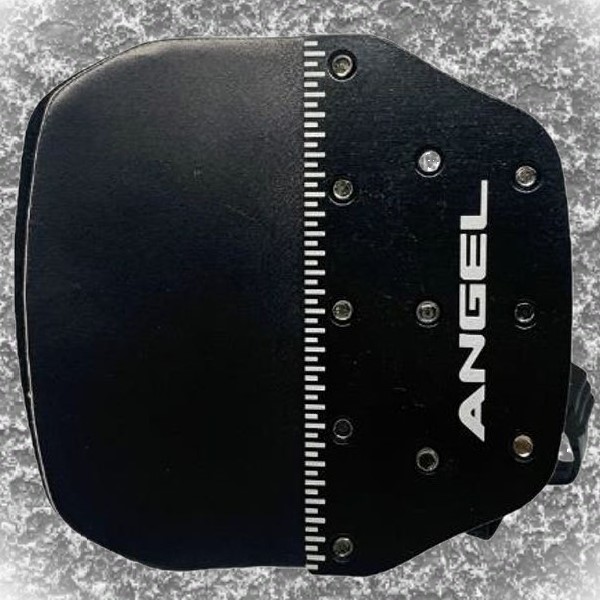
Note the strangely regular linear "decoration"!
Also known as string walking, the crawl (as shown above) refers to the technique of hooking your fingers lower on the string than where the arrow nocks. Change the position of your fingers on the string, you change the angle the arrow departs from the bow. This adjusts the arrow's trajectory so allowing you to aim at the same point on the target even though you change distances. Different crawl point for each distance. Many specialist tabs today have markings to aid consistent crawl distances on the string.
So far so hoopy. However, where it gets freaky is how you move the crawl up and down for the different distances. Normally on a recurve you move your sight UP to get the arrows to hit lower. And DOWN to get your arrows to hit higher. We all learned that as noobs. Barebow turns this on its head.
Because the crawl is effectively your back sight on the bow, it moves in the opposite direction to recurve's front sight. In other words .. if you want to move your shot up the face, move your hook UP the string. And if you want your arrows to hit lower on the face, move your hook DOWN the string. This is ONLY for barebow (or any trads playing along) who use the crawl. (We took three attempts to write this paragraph as we kept getting it back to front .. its so freaky. Hoping we got it right this time!)
And that's all we've got for you this week .. as if that wasn't disconcerting enough! Hopefully all you recurvers and compounders are now looking at barebow like the aliens they are. Honestly, its hard enough to learn about archery normally without one discipline making it up as they go! ....................... (Just joking .. lov ya fam. Well, more than compound! ;o)
Discover more from Glasgow Archers
Subscribe to get the latest posts sent to your email.


Whoa, I had to check to see if this were an April 1st post ... just kidding. Well done. I might add that you can not only crawl down the string, you can crawl up the string. (We have a traditional shoot here where all the shots are at 80 yards. Since I have a fairly weak longbow, I use a left handed tab and nock the arrow between my second and third fingers. I gain quite a bit of caast that way.) The usual strategy however is to make your longest distance your point on distance and then crawl down the string for closer shots. If that doesn't cover the entire range of target distances, it is easy enough to use another anchor and crawl down from that distance.